

By Lee Hepner
Popular depictions of cartels evoke secretive, dangerous—shamelessly glamorized—drug cartels. Or corporate whistleblowers being trailed, wiretapped, and threatened by anonymous thugs with chiseled jaws and tinted windows. Of course, there are the fat cats smoking cigars, stacking cash in back rooms and basements, cutting up maps and withholding supply to justify price hikes on street drugs or oil barrels.
The point is, we’re conditioned to think these highly illegal cartels can only flourish on the fringes of society. They so grievously violate the basic norms of honest business conduct, only hardened criminals and corporate scofflaws would partake. But the banality of contemporary price fixing is that in many markets, cartels have taken center stage. Collusive pricing algorithms transcend third party pricing consultants; they are baked into the business model of tech platforms that people use every day. The 21st Century cartel is cultivated not in smoky back rooms but in binary code.
For the past decade, legal scholars, law enforcers, and judges have grappled with how to apply centuries-old laws against price fixing to the current tech landscape, where digital pricing algorithms exploit blindspots in the law to rig diffuse markets previously thought of as unriggable. Despite the deeply-chronicled harms of price fixing—Justice Scalia once called collusion “the supreme evil of antitrust”—these price fixing algorithms are everywhere. Advertised as “revenue management systems,” or “price optimization” and “smart pricing” tools, these services can be found across industries, up and down supply chains.
Algorithmic price fixing is part of the broader trend toward hyper-financialization. As the American economy grows less interested in actually building things, price fixing and surveillance pricing algorithms solve the problem of having fewer things to make money off of by extracting greater revenues from a smaller number of things. The modern marvel of algorithmic price fixing is its ability to squeeze water from stone. For most Americans, this means higher prices, fewer choices, and an inability to discern whether the price is “right.”
Last week, California took a bold step to confront this problem, when Governor Newsom signed into law a statewide ban on coercive price fixing algorithms, a novel policy and the first successful statewide effort to combat common pricing algorithms. The bill—a bill that we at American Economic Liberties co-sponsored and were excited to see become law—emerged amid a flurry of municipal, state and federal efforts to take on allegations of rampant price fixing in the rental housing market. According to an economic study by the Biden Administration, alleged rent-fixing algorithms like RealPage cost renters $3.8 billion in extra rent in 2023 alone. In places like Denver, Colorado, which was ground zero for the first major statewide fight against rent-fixing algorithms before Governor Polis’ unceremonious veto, renters were paying a 13th month of rent every year due to common pricing algorithms.
The law is a big deal. In a 2023 speech addressing the new challenges of algorithmic collusion, former acting head of the Justice Department’s Antitrust Division Doha Mekki observed, “There may be markets and industries where long-held sensibilities … are insufficiently sensitive to market developments and thus fail to capture the broader range of harm in the modern economy.” Mekki played a key role in getting Assembly Bill 325 (AB 325) over the hump. Here’s her reaction to its adoption:
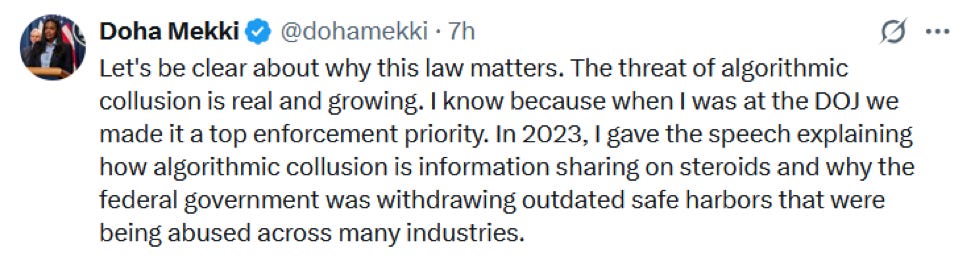 But California’s law doesn’t stop at the rental housing industry. Authored by California Democrat and Assembly Majority Leader Cecilia Aguiar-Curry, AB 325 departs from prior efforts with the recognition that many industries—not just rental housing—were being distorted by price fixing schemes. In recent years, public and private enforcers have brought federal litigation against alleged pricing cartels in the meatpacking, construction equipment rental, health insurance, college sports, and hospitality industries. It became a punchline that even frozen french fries had become cartelized—“even frozen french fries!”
How AB 325 Works
California’s new anti-price fixing law will soon be the law of the land, and already it’s putting potential offenders on edge. One indicator that corporations are calling up their legal counsel to ask what the heck just happened in California is a flurry of law firm legal advisories. And there have been several.
Big Law firm Paul Weiss, which boasts Amazon and Google on its client roster, writes that AB 325 ”may have far reaching effects on how businesses design and deploy algorithms, which are increasingly common tools.” Top 10 firm in the country Baker McKenzie observes, this “may induce an increase in private litigation alleging collusion through the use of common pricing algorithms across industries.” Boutique antitrust litigation firm Shinder Cantor Lerner heralds a more transformative shift: “Algorithmic pricing is no longer just a technical or business question. It is now squarely within statutory antitrust risk territory for companies operating in California.”
(As I was writing this, law film Pillsbury Winthrop issued perhaps the most comprehensive client alert yet, focusing on the law’s application to a wide range of algorithmic pricing schemes, the law’s very intentional rejection of a public data carveout, and the law’s application to algorithms that merely “influence” pricing. Legal heads take note.)
Several of these advisories connect AB 325 to another bill signed by the Governor last week, SB 763 (which my workplace, American Economic Liberties Project, also co-sponsored), which creates a 600% enhancement to the state’s antitrust penalties. So AB 325 is a new law with sharper teeth, too.
To be clear, any squeamishness should be reserved for third party pricing services and tech platforms that deploy common pricing algorithms to “coerce” otherwise independent businesses into participating in anti-consumer price cartels. By placing the onus on the providers, or “distributors,” of common pricing algorithms, the new California law recognizes that many businesses can be unwitting—or at least unwilling—participants in these cartels, coerced into giving up their independent pricing authority with unavoidable incentives or as a condition of accessing market research or advertising services. (For both political and policy reasons, potential small business impacts loomed large in the legislative process. Rightly so. This is, after all, a pro-business measure.)
Take the State of California’s lawsuit against Amazon, which is set to go to trial a year from now in October 2026. The lawsuit alleges, among a litany of concerns, that Amazon violates the state’s unfair competition laws by conditioning sellers’ access to the coveted Buy Box on those sellers’ compliance with Amazon’s “Marketplace Automated Repricing Service.” While that case will soon test the bounds of existing law, that allegation in particular—leveraging access to business services to coerce independent sellers into using a common pricing algorithm—is squarely within the bounds of AB 325’s ban on coercive price restraints.
In some ways, AB 325’s coercion requirement will limit the law’s ability to reach “soft” collusion, where businesses simply use a shared pricing algorithm on their own volition. But price coercion is also central to how a lot of tech platforms are structured. Platforms want businesses on their platforms to use their algorithms because restricting competition within a platform is how platforms typically compete with each other. So, as with Amazon, platforms wield access to business services to coerce independent businesses into accepting price recommendations.
Coercion can take many forms, and, while broad, it’s a term that will be tested and interpreted by courts in the years ahead. The bill’s committee analysis recognizes that coercion “can encompass a wide range of behavior,” including suppressing a sellers’ products in search results for failure to use a platform’s pricing tool. Coercion likely also includes third party pricing services that make it more difficult for independent businesses to deviate from pricing recommendations than to adopt them.
A Platform for Unrigging Platforms
The potential of a law like AB 325 is in other ways unknown—but potentially seismic. Over the past decade, tech platforms have emerged as the engineers of commerce and social interaction. They are our digital public squares. They control the flow of information across society. Their algorithms dictate the music you listen to, the videos and ideas that enjoy cultural virality, and the products that are advertised to you. More than just digital storefronts, e-commerce platforms have situated themselves as the primary way many businesses interact with their consumers—and how consumers engage with the economy.
For a half century, the relentless pursuit of scale and efficiency has tilted the scales against small- and mid-sized businesses, and the dominance of tech platforms is the apotheosis of that trend. Coercion is not a side effect of this phenomenon, but the business model itself. Coercion is the force that platforms wield to rig online marketplaces, wielding access to consumers to deprive independent sellers of their ability to set prices and other commercial terms of sale. And it’s the same set of tools used to rig the marketplace of ideas, pushing people into information feedback loops.
Whether you call it “enshittification” or “technofeudalism,” the trend toward platform dominance is one wherein a smaller number of corporations—many of whom produce little of value but the platform itself – siphon extraordinary profits from others’ productivity. Meanwhile, they stifle the competitive dynamism that we rely on broadly for redistributive abundance, new ideas and technological breakthroughs, and consumer and worker power.
AB 325 is firmly situated within a populist framework that repudiates abstract methods of control by tech platforms, daring instead to rebuild society from the bottom up.
That may sound hyperbolic, and – relative to the law’s immediate effects—it certainly is. AB 325 is an infant law, if not also the first major substantive addition to California’s antitrust law in decades. Unlike a price cap or a tax on revenue, which are blunt instruments with immediate quantifiable effects, AB 325 is a structural solution to a structural problem undergirding our economy. Its value will be revealed as it is enforced and interpreted in years to come, including—necessarily—by plaintiffs firms. For now, the stern warnings of law firm client advisories is an auspicious sign.
If nothing else, as one of those advisories states, the bill “underscore[s] the state’s efforts to prioritize its antitrust and unfair competition law enforcement.” Not soon enough. Californians can rejoice.
Lee Hepner is an antitrust lawyer and senior legal counsel for the American Economic Liberties Project.
Source: economicpopulist.substack.com, October 21, 2025