
To Local Food Systems
Commentary by Anthony Nicome
Every morning, Carl Stover steps out onto the small back porch of his family’s modest home in Loudoun County, Virginia, and hears a sound that has come to define his neighborhood: the relentless hum of a newly built AI data center beside his house.
Loudon County, with about 200 data centers, is arguably the data center capital of the United States. “Some mornings I stand out here and try to remember what it sounded like before,” Stover says, resting his arms on the porch railing as the steady hum of cooling equipment fills the air. “The birds are still here, but now they have to compete with the noise.”
Roughly 100 yards behind his house, there once stretched green patches of farmland and a community garden where neighbors tended tomato vines, pepper plants, and herbs. But those fields and community garden are gone now, converted over the last few decades into concrete and server racks in the name of progress. The arrival of the new center only magnifies the problem—and Stover’s experience is anything but unique.
There are now more than 3,000 data centers in the U.S., along with more than 1,500 facilities in development. While these centers power the digital economy, they also consume extraordinary amounts of water to cool servers, sometimes withdrawing millions of gallons per day in regions already strained by drought or groundwater depletion. Their massive electricity consumption can stress regional grids, push communities toward more polluting energy sources, and drive up energy costs.
In Texas, Michigan, New Mexico, Wisconsin, Pennsylvania, and many other states, the centers are taking over large swaths of farmland or flat, open parcels that would otherwise be ideal for farming, community gardens, orchards, or green space. In central Washington, we’re already seeing data centers replace family orchards that produce some of the state’s most iconic crops, like cherries.
As these centers proliferate, they are placing growing pressures on agricultural land access, water availability, and local energy costs—factors that can affect local food production, food affordability, and long-term food-system resilience. If we want to protect our food future, we must protect our farmland.
Food Producers on the Front Lines
As an environmental justice advocate, I am deeply troubled by where and how we’re building the backbone of our digital future. The physical infrastructure of AI is increasingly dropped into places that can’t absorb the costs.
Rural Mason County, Kentucky, is a case in point. Farmers and residents here are fighting a proposed hyperscale data center project that could consume thousands of acres of farmland deeply tied to the region’s agricultural identity and generational heritage.
Unlike traditional data centers, which are generally 100,000 square feet or less, hyperscale data centers are massive facilities that can cover 200,000 to several million square feet and consume as much energy as some cities or even U.S. states. They house thousands of servers and support cloud computing, artificial intelligence, and other large-scale digital services.
Farmers here have reportedly been offered millions of dollars for their land, but many have refused.
“You can’t get food out of a data center,” local farmer Ida Huddleston told People. “Everything comes from the land. Once you tear it up, you can never replace it again.” She and her family ultimately declined a $26 million offer for their land.
Community members, including farmer and Germantown City Commissioner Max Moran, have warned in a recent podcast that the proposed hyperscale data center could impact roughly 2,100 acres of productive farmland, and if the zoning changes are approved, other centers are poised to follow, potentially impacting as many as 10,000 acres here.
They say data centers threaten not only water resources, energy infrastructure, and quality of life there, but also the long-term survival of family farming. They worry about the project’s limited transparency, too—some city officials signed nondisclosure agreements—and the noise and traffic.
For Moran, the fight is deeply personal. When interviewed for the podcast, he stood on land his family has farmed for at least six generations, reflecting on a heritage that stretches back further than he can trace.
“Money isn’t everything, and the real value when it comes to the land is being able to pass it down to your next generation,” Moran said.
The loss of farmland here, say Moran and other locals, would erode nearby food production capacity, dismantle agricultural heritage, and accelerate the disappearance of rural farming communities already under pressure nationwide.
“I think people should know that it’s taking up a lot of the farmland where their food comes from,” Jonathan Bowles, a Mason County fifth-grader, told WCPO 9 news.
When Data Centers, Food Systems, and Public Health Collide
The buildout of data centers on farmland could be especially damaging in regions with marginalized communities that already grapple with food insecurity and environmental burdens such as air and water pollution. Every acre converted into an industrial complex is an acre lost to potential farms, community orchards, or green spaces that help residents access fresh, affordable food. This would include Indigenous communities with ties to land that goes back thousands of years, and for whom land is synonymous with well-being.
A lack of viable land impacts residents’ ability to raise or gather their own food, further driving negative public health outcomes. Weakened local agriculture means fewer farmers’ markets, school garden programs, and community food hubs, and more reliance on long, fragile supply chains.
When water is scarce or diverted, growers struggle. When energy costs rise because of growing demand on local power infrastructure, the cost of refrigerating, transporting, and processing food increases as well. Siting data centers in vulnerable communities already impacted by environmental inequities could further degrade their health and safety and erode their ability to feed themselves affordably and sustainably.
A Call for Oversight
Perhaps most troubling, the data center boom is unfolding as federal environmental oversight weakens. Recent cuts to environmental research and environmental justice programs have reduced support for community engagement, impact assessments, and climate initiatives. Communities now have even fewer resources to challenge harmful projects or advocate for better alternatives.
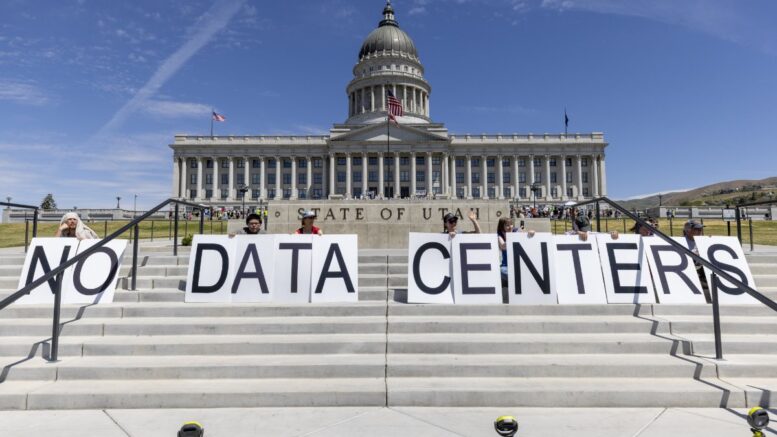
If we are serious about food justice, environmental justice, and public health, then we must challenge the rapid, largely unregulated buildout of data centers. Communities deserve transparency, participation, and power over what gets built in their backyards and how it affects the resources they depend on.
This begins with comprehensive, cumulative impact assessments that examine how data centers affect water availability, air quality, land use, agricultural capacity, energy demand, climate resilience, and public health. These assessments must be rigorous, public, and conducted before any permit is approved.
Data center impacts are inherently local. Therefore, community engagement beyond public comment periods is key. Counties and municipalities, for example, should work with community-led organizations to establish data-center oversight boards. These boards should bring together residents and representatives from permitting, environmental, and public health agencies, local universities, and community-based organizations.
Such bodies can ensure that the lived experiences of residents, particularly those in communities most likely to bear the impacts of development, are reflected in decision-making, planning, and accountability efforts. Local governments should also require ongoing public reporting on data center water use, energy consumption, and environmental impacts.
Legislative measures can be taken to protect farmland and potential community food-producing spaces. For example, in Skagit County, Washington, local officials recently placed a temporary ban on new data-center applications specifically to prevent the loss of farmland and protect water resources.
Agricultural parcels, green space, and land critical for local food access should be off-limits for data center development. If data centers truly must be built, they should be placed in areas that cannot support agriculture or local food production, rather than in the spaces capable of sustaining it.
The facilities themselves must be designed sustainably. From the earliest stages of planning and design, the facilities should incorporate emerging best practices for integrating renewable energy, water-efficient cooling technologies, and waste-heat recovery systems that can supply energy for nearby buildings and communities. And while efforts are underway, these approaches remain largely experimental and unproven at scale.
Finally, we need robust research on how AI infrastructure interacts with food systems and public health. That means studying land-use changes, water withdrawals, agricultural displacement, pollution, and the cumulative effects of clustered data center development. Without this knowledge, we risk making decisions blind to their long-term consequences. The tension unfolding in Mason County and across the country illustrates a fundamental truth: People want a future shaped by innovation, but that future must value their health, water, land, and right to feed their families. Technological progress should not come at the expense of community survival.
We do not have to choose between innovation and nourishment, technology and equity, or progress and public health. We only have to choose to plan wisely and listen to the communities who have always understood that the land beneath their feet, the water they drink, and the food they grow are worth more than anything a data center can offer.
Anthony Nicome is a public health and environmental justice strategist and serves as an advisor to the National Academy of Medicine Climate Communities Network.
Source: civileats.com, June 24, 2026