
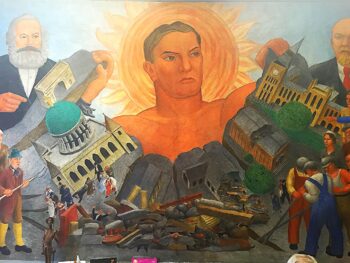
Commentary by Vijay Prashad
The refashioned liberals and social democrats are back. They have positioned themselves as the saviors of the world; they act as Reason to the unreasonableness of neo-fascism. This is possible because their forebearers have collapsed in the puddle of neoliberalism and technocracy, and because their adversaries now present themselves as the howling wolves of the extreme right. The refashioned liberals and social democrats are like zombies, the reanimated corpse of a dead liberalism.
These refashioned liberals and social democrats have a point. Their immediate predecessors had taken their liberal tradition and exhausted it in the fires of austerity and debt. From the British Labour Party to the Indian Congress Party, the old liberals and social democrats in the West and the anticolonial freedom fronts in the Global South bowed down when the Soviet Union collapsed and began to conform to four realities of their own making:
That capitalism is eternal.
That the neoliberal policy framework (capitalism let loose) is inevitable, even if it creates extreme inequality and does not advance social goals.
That the most that can be done by us is to improve society by ameliorating certain specific social hierarchies (such as those around race, gender, and sexuality).
Finally, following the poorly conceived warnings of Friedrich Hayek in The Road to Serfdom (1944), that pursuing anything more than mere amelioration is folly because it is either bound to fail or inevitably reproduce the “autocracy” and “bureaucracy”‘ of the Soviet Union.
As the old liberals tied themselves openly to the austerity-debt agenda of neoliberal policy, they refashioned themselves as technocrats and began to style themselves as the sole arbiters of what in popular opinion was acceptable to their technocratic vision. This acceptance by liberals of the gripping pain of austerity and the rejection of its critique allowed the extreme right to cloak itself as the people’s representatives and strike a populist tone through the ugly rhetoric of anti-immigration and “anti-woke,” but marrying it with their incoherent criticisms of the economic system. The extreme right emerged largely on the coattails of liberal surrender to neoliberalism. But the extreme right has not broken with the general outlines of neoliberal policy. It replicates it alongside a harsh social agenda. Despite all the talk of economic nationalism, the extreme right does not have an original economic agenda.
The refashioned liberals and social democrats ignore the surrender of the old liberals to austerity and debt and refuse to do an accounting of the ways in which liberal technocracy laid the foundation stone for the extreme right. To position the return of liberalism as if it could save civilization from the extreme right is misleading, since this refashioned liberalism and social democracy has no different formulation about the way forward than their predecessors. Nothing from the refashioned liberals or the social democrats provides confidence that they are prepared to break the austerity-debt-finance conservatism agenda of neoliberalism. What we have is a left-sounding rhetoric and agitational sensibilities against the system, but incoherence when it comes to how to move beyond the atrocities of capitalism. Specifically, there is nothing in the form of an economic policy that addresses the gross inequality that characterized the neoliberal period. Dig deep into the political agendas and programs of the new social democrats and, amid a festival of identity politics jargon (not even taking seriously the demands for dignity in contexts of social oppression), you will be hard-pressed to find an economic agenda that restores rights or builds power for the masses. At best you will find conservative redistributive policies that attempt to rebuild a middle class that social democracy considers its real base—eschewing any ambition to represent and organize beyond it and into the working class and the peasantry who comprise the vast majority of the world’s people.
A set of slogans—for instance, technofeudalism (Yanis Varoufakis), democratic setbacks (Red Futuro), progressive capitalism (Joseph Stiglitz), rights with responsibilities (Third Way)—breed this disjointedness and offer a nostalgic sense that there was once a democratic system rooted in a perfectly competitive capitalism. Such a golden age did not ever exist: capitalist competition is driven toward monopolization, and to the use of state power (often with violence) to exert the will of this or that company, and to reduce the share of wealth that is distributed to society as a whole through wages and taxes, while members of the capitalist class accumulate income and wealth to themselves and amass more capital to continue their dominion.
Further, hearkening back to a “gentler” capitalism of the postwar period ignores that this model depended on the severe exploitation of labor and predatory resource extraction of the Third World—built on the backs of coups d’état and military interventions intended to suffocate the sovereignty of the postcolonial states. While workers in the Global North may have briefly enjoyed marginal stability and relative prosperity during the “Golden Age of Capitalism” (1945–1973), for workers around the globe this was not an age of prosperity. This golden age was built on the neocolonial economic structure of theft that maintained itself through imperialist coups (from Iran in 1953 to Chile in 1973) against any country in the Third World that tried to establish its sovereignty and through the refusal to allow the Third World states to implement the New International Economic Order (1974) formulations voted in by the United Nations General Assembly. The neocolonial system financed the golden age, and, through the operations of the International Monetary Fund and the large multinational corporations, it remains the defining system today. Capital continues to flow as “tribute” from the Global South to the bank accounts of bond holders in the Global North, most of whom take this liquidity and plough it into a vast financial casino rather than making large-scale industrial investments (although this does not mean that large investments are not being made in actual infrastructure by the billionaire class in areas such as Artificial Intelligence and weapons production).
A more coherent proposal from the perspective and experience of the Global South would be to rebuild the nationalist economic agendas that were dismantled by U.S. interventionism. This, however, is sorely lacking from the vision advanced by refashioned liberals and social democrats, who have built an analysis derived from wistful nostalgia for European welfare states and the New Deal in the United States. A “return to golden age capitalism” or building a “capitalism with a human face” is an illusion that the world’s people cannot afford.
A remarkable survey published in 2024 by the Alliance of Democracies called the Democracy Perception Index found that the majority of people questioned about the threats to democracy listed three as the main problems: concentration of income and wealth, corruption, and corporate control over political life. Interestingly, 79 percent of the Chinese population say that their country is democratic, much higher than in any Western country. This survey, done by a pro-Western liberal think tank, shows that the Chinese population believes that their government does more for them because it puts the needs of the vast majority ahead of the needs of the capitalists around the world. At a time when there is global interest in socialism, and with the possibilities of finding some lessons from the Chinese experience of breaking the dependency barrier, the return to “progressive capitalism” and social democratic milquetoast ideas seems misplaced. Exhausted ideas of liberal democracy and free market capitalism do not need to be reanimated by a new zombie liberalism.
The Need for Clarity and Class Struggle
The current conjuncture requires a movement between two political concepts: sovereignty and dignity. These are intertwined concepts of our era, with different movements and state projects operating with relative degrees of commitment to each of them.
National sovereignty is a state-level concept referring to state projects that push against the intervention of foreign interests and seek to develop a political and economic set of policies that defend the rights and needs of their own people. For a country that has emerged from colonialism, sovereignty is a mechanism to measure how much the country has been able to exit the pressures of colonial rule and imperialist intervention.
To seek sovereignty is by itself a negative assertion, meaning that it is against imperialist intervention; the category of sovereignty itself does not describe the nature of the class relations within the country, allowing for countries to have nonsocialist paths but nonetheless sovereign paths from imperialism (Iran, for instance, is not a socialist state, but it nonetheless seeks sovereignty from the clutches of imperialism). All socialist state projects decidedly seek national sovereignty, but all sovereign seeking projects are not socialist.
Dignity is a people-level concept that refers to the idea that each person and then the social communities to which they belong as social individuals seek dignity in all aspects of their life, from a dignified everyday life (emancipation from poverty and hunger) to a dignified cultural life (celebration of their own cultural heritage as part of human culture).
The concept of dignity is widely shared across human history, from the traditions of Buddhism (everyone has Buddha nature in them) to Stoicism (dignitas or worthiness shared by all rational beings); the United Nations Declaration of Human Rights (1948) opens with the recognition of the “inherent dignity” of all “members of the human family.” But dignity is not an a priori fact of humanity (as humanism or liberalism argues); it must be produced as we exit the wretchedness of deprivation (poverty, illiteracy) and form dignified lives (as socialism argues). There is, in other words, a material force that must shape our dignity. A politics to produce dignity is a socialist politics, although others might adopt this or that element of the socialist program. There is no evidence in the world that the capitalist system can emancipate all people from a life of indignity: capitalism inherently generates forms of inequality and indignity. Therefore, all undertakings that seek dignity for all are socialist projects.
One of the most complicated aspects of our present state of the world is that while there is chaos in the North Atlantic world, there seems to be a growing sense of stability in parts of southeast and east Asia. The old imperial powers continue to insist on a world of austerity, debt, and war—ugly ideas that bring grief to billions of people, from those Palestinians who face the Israeli genocide to those who starve to death in their homes because their precarious work does not earn them enough to survive.
Meanwhile, particularly from China, the message is clear: we must work toward peace and development in order to create a shared future for humanity. This is a call that increasingly seems more attractive to people around the world. This is where the refashioned liberals and social democrats appear to be so cut off from reality: being accustomed to the Cold War-era liberal language of authoritarianism, they are unwilling to properly acknowledge the great gains made against all odds in places such as China and Vietnam to lift their populations out of poverty, to build new, quality productive forces, and to offer technology transfer and economic and technical collaboration for the industrialization of large parts of the Global South that had suffered from the yoke of the neocolonial structure of globalization. China and other Asian countries have not solved the problems of the world; they do not offer an “off the shelf” model for development. But they offer a stance toward the world—peace and development—that is far more attractive than that offered by the old North Atlantic states in the name of liberalism—austerity, debt, and war.
It is not as if refashioned liberals and social democrats are so eager to build mass movements and to abjure state power. They believe that state power can be won through the ballot box in liberal democracies and that this can be done by disassociating themselves fundamentally from the aim of socialism, from the history of socialism, and from the actual experience of socialist state projects. But that would be a hollow state power, because it would mean taking office without power, without building the movements and political organizations that come with a mass base that is gripped with clarity, confidence, and an appetite to realize full human dignity. The class struggle remains the central battlefront to build the dignified protagonists of the future.
The world wants to advance to socialism.
Vijay Prashad is the director of Tricontinental: Institute for Social Research. Prashad’s latest books are On Cuba (with Noam Chomsky) and The International Monetary Fund Suffocates the World (with Grieve Chelwa).
Source: monthlyreview.org, November 2025. A longer version of this article can be found on the website.