
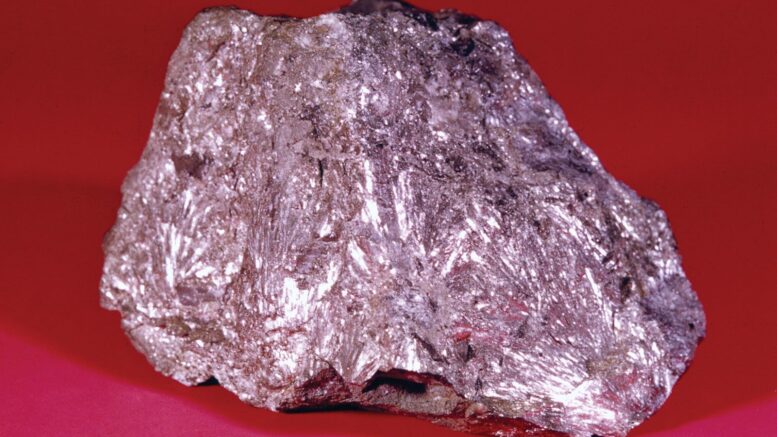
Antimony and the existential fragility of American military power
By Shanaka Anslem Perera
I. The confession hidden in plain sight
Buried in paragraph 47 of the Defense Logistics Agency’s September 2025 contract announcement was a phrase that should have triggered congressional hearings, front-page investigations, and immediate executive action. Instead, it passed through the American news cycle in approximately fourteen hours, noticed by precisely nobody who should have noticed it.
The phrase was “sole-source.”
The Defense Logistics Agency, the Pentagon’s procurement arm responsible for ensuring American forces can fight and win wars, had just awarded a $245 million contract to supply antimony ingots for the National Defense Stockpile. The contract was not competitive. There was no bidding process. There were no alternative suppliers evaluated and rejected on merit. The contract went to United States Antimony Corporation because United States Antimony Corporation operates the only two antimony smelters in North America.
There are no others.
Read that again. The United States of America, which spends more on defense than the next ten nations combined, which maintains eleven carrier strike groups and 750 military bases across 80 countries, which projects power into every corner of the globe, cannot refine antimony without the facilities of a single company headquartered in Thompson Falls, Montana, population 1,319.
The strategic implications of this fact are so severe that they border on the classified. Antimony trisulfide is not optional for ammunition. It is not a performance enhancement that marginally improves reliability. It is the friction-sensitive compound that ignites when a firing pin strikes a primer. Without antimony, bullets do not fire. Artillery shells do not detonate. The primers in over 300 types of American munitions, from 5.56mm rifle rounds to 155mm howitzer shells, require this specific metalloid with this specific chemistry.
Colonel Steven Power of Picatinny Arsenal, the Army’s primary research and development center for armaments, stated the reality with unusual bureaucratic candor in testimony that received virtually no media coverage: antimony trisulfide is “an essential and non-replaceable component” of American ammunition. The Colonel used the word “non-replaceable” because it is true. There is no synthetic substitute. There is no alternative compound. There is no workaround that maintains military specifications. The physics and chemistry of percussion ignition require antimony. The requirement is not negotiable.
Now consider what happened between August 2024 and December 2024.
On August 14, 2024, China’s Ministry of Commerce announced export licensing requirements for six categories of antimony products. The announcement received approximately the same coverage as a mid-tier earnings miss from a regional bank.
Commodity traders noticed. Defense analysts did not. The licenses were nominally available. In practice, applications disappeared into an approval process designed to produce no approvals.
By September 15, when the licensing regime took effect, Chinese antimony shipments to Western markets had collapsed by 97 percent. Not a gradual decline. Not a managed reduction. A near-total cessation that left European inventories below 60 days and American manufacturers scrambling for material that increasingly did not exist at any price.
On December 3, 2024, Beijing removed all ambiguity. The Ministry of Commerce explicitly banned antimony exports to the United States, citing national security and the metal’s “dual-use” military applications. The message was unmistakable: if the United States wants to manufacture ammunition, it will do so without Chinese antimony.
The price response was not subtle. Rotterdam quotes for antimony ingots, which had traded near $11,300 per metric ton in January 2024, reached $57,778 by April 2025. At certain moments during the tightest supply conditions, offers approached $60,000. This represents a 400 percent increase in 18 months, the sharpest rally that Fastmarkets has recorded since it began tracking antimony prices in the 1980s. It is not merely the largest move in antimony history. It is the largest move in the history of any critical mineral during peacetime conditions.
Peacetime is doing significant work in that sentence.
II. The doctrine demonstration
The common interpretation of China’s antimony restrictions frames them as retaliation for American semiconductor export controls. This interpretation is not wrong, but it is dangerously incomplete. It treats the antimony action as tit-for-tat, a proportional response to a perceived provocation, a move in an escalation sequence that might be reversed through negotiation or regime change or diplomatic creativity.
This interpretation misses what actually happened. What actually happened was a doctrine demonstration.
China did not merely restrict antimony exports. China proved that it possesses the capability to sever the ammunition supply chain of the world’s dominant military power. The proof required no military action, no kinetic engagement, no risk of the escalation spirals that constrain great power competition. The proof required only administrative action and the patient accumulation over decades of a structural monopoly that American policymakers failed to prevent and now cannot quickly undo.
The sophistication of Beijing’s approach deserves analytical respect that it has not received. Examine the escalation sequence: gallium and germanium restrictions in July 2023, graphite export controls in October 2023, rare earth processing technology bans in December 2023, antimony licensing in August 2024, and the explicit American ban in December 2024. Each step targeted a different vulnerability. Each step taught a different lesson. Each step raised the stakes while preserving deniability and creating opportunities for off-ramps that the other side might decline.
The antimony restriction was not chosen randomly from a list of possible commodities. Antimony was chosen because it demonstrates maximum leverage with minimum visibility. Unlike rare earths, which have cultural resonance from the 2010 Japan crisis, antimony operates in a zone of public ignorance that borders on the absolute. The median American voter has never heard the word. The median congressional staffer cannot spell it. The median defense journalist could not identify its applications without research. This obscurity is not incidental. It is the point.
Beijing demonstrated that it can cripple American ammunition production through a mechanism that the American public cannot understand, through a material that the American media cannot explain, through a supply chain that the American defense establishment failed to monitor. The demonstration was so effective that it produced minimal political cost in the United States while forcing the Pentagon into a billion-dollar panic procurement that will take years to fully execute.
This is what victory looks like in 21st-century great power competition. Not carriers sunk. Not cities bombed. Not troops defeated in the field. Victory looks like an adversary’s industrial base quietly hollowed out through the patient exploitation of dependencies that nobody noticed until the moment of maximum vulnerability.
The November 2025 suspension of the export ban, announced following the Trump-Xi summit in Busan, should not be misinterpreted as strategic retreat. China did not permanently restore access. China issued general licenses for commercial end-users, valid for 13 months, while maintaining absolute prohibition on military end-use exports. The Pentagon still cannot buy Chinese antimony. American defense contractors still cannot source from Shanghai. The temporary easing for commercial buyers is a pressure valve, not a policy reversal.
Shanaka Anslem Perera: Author & Independent Analyst. Exploring money, geopolitics, AI, science, and sovereignty. Mapping the collapse and the reconstruction of order.
Source: shanakaanslemperera.substack.com, December 25, 2025