
To Fight Against Labor Zionism
By Suzanne Adely
Challenging Labor Zionism
Labor for Palestine was created in 2004 through the collaboration of anti-Zionist union leaders and Palestinian and Arab grassroots organizers in Al-Awda-NY, the Palestine right to return coalition. It emerged in response to a growing labor antiwar movement that refused to take up the issue of Palestine. This refusal was rooted in the liberalism of the movement’s core politics, which lacks a clear analysis of U.S. imperialism and labor hierarchy’s connection to it.
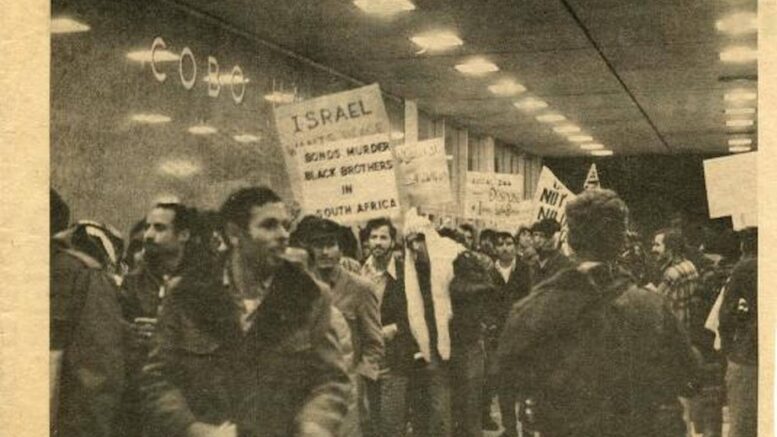
Labor for Palestine sought to reclaim the legacy of working-class solidarity with Palestine in the United States, as reflected in groundbreaking statements by the League of Revolutionary Black Workers in 1969, and wildcat strikes led by Arab Auto workers against the United Auto Workers (UAW) leadership’s support for Israel in 1973. These labor actions in the late 60s and early 70s signified the first call for Boycott, Divestment and Sanctions against the Zionist entity in the US, while also demanding racial justice, worker justice, union democracy, and international solidarity with all workers in the Global South liberating themselves from colonial oppression. The call was grounded in anti-colonial, global worker internationalism.
In February 2007, Palestinian trade union bodies appealed directly for support, including a request for international labor to cut ties with the Histadrut, the Zionist labor federation. Histadrut has used its image as a “progressive” institution to spearhead—and whitewash—racism, settler colonial dispossession, genocide and ethnic cleansing against the Palestinian people since the 1920s, serving as the cornerstone of Labor Zionism. While these calls received wide-ranging support from trade unionists in South Africa, the U.K., Ireland, Canada, Norway, and elsewhere, the presence of top-down Labor Zionism in the U.S. labor movement made solidarity challenging.
Over the years, Labor for Palestine encouraged workers to support the Palestinian trade union call and honor the “BDS picket line.” As the Zionist entity’s colonial violence intensified through periodic bombings, ethnic cleansing, and a criminal land, sea, and air economic blockade imposed on Gaza, more workers and labor leaders in the U.S. began to voice support. For over 15 years prior to the current genocide, Gaza had been subjected to a comprehensive blockade that, as UN Special Rapporteur Francesca Albanese documented, transformed the territory into “an open-air prison” through a system of “economy of occupation” designed to dispossess and control the Palestinian people. The number of rank and file union members joining Palestine solidarity organizing expanded exponentially following October 7th, many pushing for their unions to pass BDS resolution or, at a minimum, resolutions expression solidarity with the Palestinian people, calling for a ceasefire and the end of US military and economic support for the Zionist entity.
It is in this context that the Labor for Palestine national network in the U.S. has expanded to over 50 affiliates across various sectors, industries, and geographies. This recent growth is a direct response to the depravity of the genocide, but more importantly, it has been inspired by the global solidarity movement and Palestinian resistance itself. Every fight for Palestine solidarity within the labor movement has helped build class consciousness, internationalism, and strengthen worker democracy.
Today, Labor for Palestine National Network calls on all organized workers in the U.S. and globally to hold their union bureaucracies accountable and to use organized worker power to end the genocide and challenge the capitalist-imperialist economy that fuels and benefits from Zionist settler colonialism.
Unique among labor and other Palestine solidarity formations in the U.S., Labor for Palestine affirms the right of the Palestinian people to resistance, including through armed struggle—a right entrenched within international law, particularly in the context of the fundamental principle of self-determination. Recognition of anti-colonial resistance, in all its forms, was central to the internationalism expressed in the statements of the League of Revolutionary Black Workers and the Arab Workers Caucus in the 60s and 70s. Anything less would undermine true internationalism.
There are forces within the U.S. labor movement that have sought to undermine this solidarity through anti-democratic tactics at every step over decades. Their tactics have often manifested in racist attacks against the Palestinian movement, legal attacks, firings, and isolation, and were often led by those directly aligned with Zionism and the Democratic Party. Yet it is important to note that labor Zionism was not inherent to the worker movement in the U.S.
Growth of Labor Zionism
Through the 1930s, Jewish workers in the United States were adamantly anti-Zionist. The early radical worker movements in the US, which included many Jewish labor leaders, opposed the Zionist project. Significant, militant, and foundational worker struggles took place in the U.S. in the late 19th century led by Black and immigrant workers, often motivated by socialist, anti-racist, and other strong liberatory beliefs. As Zionist settler colonialism began to take shape in the early 20th century, there was a working-class movement in the US more radical than anything we have seen today.
A deliberate campaign by Zionist institutions sought to build support for labor Zionism in the U.S.. Histadrut, established in 1920, played a significant role in facilitating the rise of Zionism, the colonization of Palestine, and the exploitation of Palestinian workers, while also building support for Zionism in the United States. The growth of labor Zionism in the United States coincided with a deliberate campaign to purge US unions of left politics and to build labor institutions aligned with the Democratic Party that would not pose a significant threat to the status quo of capitalist growth and imperialism.
Labor Imperialism and Counterinsurgency
Militant and organized workforces, particularly those built on foundations of class consciousness and internationalism, have always been a threat to U.S. capitalism and its imperialist growth. This is precisely why the U.S. celebrates Labor Day and not May Day, despite the holiday’s origins in the Haymarket uprising in Chicago.
The 1947 anti-worker Taft-Hartley Act contained a major anti-communist provision requiring union officers to sign affidavits swearing they were not members of the Communist Party to access the National Labor Relations Board (NLRB). Although this provision was ruled unconstitutional in 1965, it helped lead to the purge of left-wing leaders and the expulsion of 11 unions (representing nearly 1 million workers) from the Congress of Industrial Organizations (CIO).
The American Federation of Labor historically emerged as a staunch collaborator with the anti-communist purge of the U.S. labor movement, as well as a collaborator with the U.S. imperialist apparatus. This weakening of militant labor struggles led to the merging of the AFL-CIO, which would continue to play this role in the following decades.
Throughout the Global South, the AFL-CIO has collaborated with U.S. imperialist policy to weaken left-wing labor and socialist movements, anti-imperialist peoples’ struggles, and national liberation movements. Many rank-and-file labor organizers and historians have documented this history. In fact, its role—particularly in the Cold War era—was so central that the AFL-CIO and perhaps other parts of the U.S. labor hierarchy can be seen as a structure of U.S. counterinsurgency itself.
Referring to the AFL-CIO’s role in the U.S. imperialist project as counterinsurgency (COIN) reflects a broad understanding of COIN. The 1935 Small Wars Doctrine created for the Marine Corps described COIN as “operations undertaken under executive authority, wherein military force [US] is combined with diplomatic pressure in the internal or external affairs of another state whose government is unstable, inadequate, or unsatisfactory for the preservation of life and of such interests as are determined by the foreign policy of our nation.” A 2018 military manual added that “an effective COIN operation will utilize all instruments of national power to integrate and synchronize political, security, legal, economic, development, and psychological activities carried out by the host nation (HN) and applicable USG and multinational partners to create a holistic approach aimed at weakening the insurgents while simultaneously bolstering the government’s legitimacy in the eyes of the contested population.”
Both quotes demonstrate that COIN is conceived as a broad and multi-layered framework that does not confine itself to military operations, but encompasses “political, economic, military, paramilitary, psychological and civic actions” fundamentally aimed at the politics of the “insurgent.” The term “insurgent” or “insurgency” is itself a COIN tactic, deployed to delegitimize liberation struggles as criminal acts.
Building Internationalism
The inhuman genocide and the heightened repression of those challenging it, increasing racist violence, and militarized law are all expressions of a US hegemony desperate to hold onto its power in the face of a changing world—a crisis of capitalism and imperialism born of resistance to it. International worker and people’s solidarity frightens them; the international support for Palestinian resistance terrifies them.
One of the last essays the economist Samir Amin co-published with Firoze Manji emphasized the importance of building a new “transnational alliance of workers and oppressed peoples of the entire world” to “counteract the spread of contemporary imperialist capitalism.” This idea speaks to a renewed internationalism necessary in the face of a consolidated global oligarchy that controls global production and knowledge chains. This system underlies today’s neo-colonialism, super-exploitation of Global South workers, disposability of peoples, and consolidated systems of fascism manifested in global militarized police forces, surveillance, and security regimes. The level of impunity enjoyed by Zionist, colonial, and imperialist violence is equally a sign of this crisis.
A renewed internationalism of “workers and oppressed peoples” is another key, often overlooked point. We cannot limit our local or global movements to traditional concepts of the working class. The chain of capitalist and imperialist exploitation and oppression extends far beyond “unionized workers” in any location. The difference lies in proximity to power and proximity to resistance against it. As workers in the imperialist core, we must build a united front to challenge the repression of our movements here, while working not only to challenge the genocide but to dismantle the imperialist supply chain itself.
Suzanne Adely is the President of the National Lawyers Guild (NLG), Co-Convener of the US Labor for Palestine, and member of the National Coordinating Committee, with the U.S. Palestinian Community Network (USPCN).
Source: anti-imperialists.com, March 2, 2026