
Conditions at Arkansas prison and former plantation
By Victoria Valenzuela
Prisons often frame agricultural labor as “rehabilitation,” but incarcerated people say their working conditions are dangerous and dehumanizing.
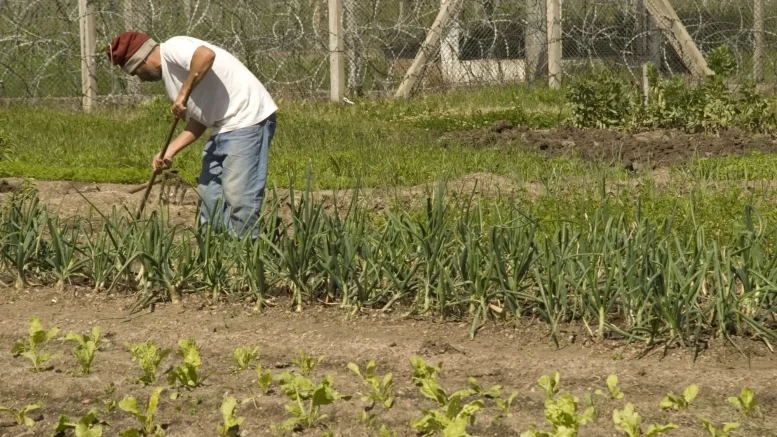
AT spent nearly every day for five months on his hands and knees, picking weeds, planting seeds, and using a hoe to clear a patch of field as armed guards on horses watched. Sometimes, the guards at his maximum security prison verbally abused the workers.
AT, who is using his initials for fear of retaliation, was just one of hundreds of incarcerated men forced to work for free as part of the “Hoe Squad” at the Cummins Unit, the Arkansas Division of Correction’s (ADC) oldest and largest prison. In an interview with Prism, AT said the conditions at the Cummins Unit reminded him of slavery, with the officers on horses serving as plantation overseers.
“I used to dread getting up and going out there,” AT said. “I’m a pretty laid back, easygoing person, humble, but once I get out there, I used to get to the point where it’ll remind me so much of what slavery must have been like.”
This was echoed by Mela-Sidq Supreme, who had also worked on the Hoe Squad.
“The Hoe Squad at the Cummins Unit is as close to slavery as any person will ever get in the United States,” Supreme said. “I’m on my hands and knees, and I’m planting onions in this field. I looked up and the only thing that I could see was white men on horses with shotguns, and as I looked around me, all I could see in my mind were Black men on their knees planting onions. We were literally slaves.”
Arkansas is one of the seven remaining states that does not pay incarcerated people for their labor. The “exception clause,” found in the 13th Amendment of the U.S. Constitution, allows for slavery under punishment.
Across the U.S., the Cummins Unit is just one of hundreds of prison farms, correctional facilities where incarcerated people are forced to do agricultural work. Most of the food harvested is sold to outside companies for thousands of dollars per contract. Meanwhile, the people doing the labor at Cummins Unit are largely not allowed to eat the food they grow and harvest, workers told Prism.
ADC did not respond to requests for comment. However, a 2025 press release about its agriculture program alleged that positions such as those on the Hoe Squad “are highly sought after by many housed in Arkansas prisons since these jobs offer education and hands-on work experience that can be used upon release. Incarcerated Individuals get invaluable training while still serving their time, and they gain a sense of worth knowing they are bettering themselves.”
While prisons often frame this free agricultural labor as “rehabilitation,” incarcerated people who spoke to Prism said their working conditions are dangerous and dehumanizing. In addition to working in fields, people in prison are forced to work for free in meat and poultry processing plants, on dairy farms, and in stables. Some of these facilities, like the Cummins Unit, are the sites of former plantations. Many of these prison workers have sustained injuries, and some have even died due to dangerous workplace conditions and machinery that they sometimes operate unsupervised.
According to advocates, the root cause of these serious problems is the 13th Amendment.
Akin to slavery
The state first bought the Cummins property in 1902 to operate as Arkansas’ first working prison farm. From the time of its opening until the 1930s, the prison solely incarcerated Black Americans, who were required to pick cotton.
Before it was the Cummins Unit, the prison was the site of two plantations. In 1873, eight years after slavery ended, Arkansas codified a convict-lease system that allowed individuals and companies to pay the prison to “lease” incarcerated people to work in factories and mines and on farms and railroads. The workers were not compensated for their labor.
In 1893, the state revised its convict-lease program, giving the Arkansas Penitentiary board the rights to purchase or lease farms, which continues to allow the state to profit from the unpaid labor of incarcerated workers.
There are currently more than 660 prisons in the U.S. with agricultural operations, and while some prison farms do pay incarcerated workers, Arkansas does not.
“When looking at the history of prison development in the United States, agricultural operations were really fundamental to the development and growth of the prison system, particularly after the abolition of chattel slavery … to reduce the cost of their operations to the captive labor force,” said Joshua Sbicca, director of the Prison Agriculture Lab, a research and advocacy organization focused on agricultural practices in the criminal legal system.
Like ADC, prisons officials nationwide often frame their agricultural operations as “rehabilitative” because they allow incarcerated people to gain work experience. However, those forced to work for free have brought lawsuits against prisons to end these exploitative programs.
“Rehabilitation can be used as a buzzword to justify really harsh prison conditions and really harsh labor conditions,” Sbicca said. “In the case of [Cummins Unit], the Hoe Squad is infamous, and prisoners have been writing about their experience as akin to slavery for a really, really long time.”
This was echoed by Santana, who is incarcerated at the Cummins Unit and is using a pseudonym for fear of retaliation.
“Rehabilitation would mean that we would once have to be habilitated,” he explained. “But most of us had come to prison while we were young, so we [had] never been to the state where we need to get back to. ‘Re-’ means going back to something.”
AT said that while those incarcerated at the Cummins Unit don’t have much of a choice as to whether they work, they also don’t fight it because they want to avoid punishment.
Men who refuse to work can be put in solitary confinement. Additionally, the type of farm job ADC assigns to incarcerated people is based on their prison classification. Someone with a high classification must first prove they aren’t a danger or flight risk, so they typically start on the Hoe Squad. Once they’ve proven themselves to prison officials, their classification status is lowered, and they can move on to other forms of work. Men can also have their classification status heightened. AT told Prism that prison officials often use the Hoe Squad as a form of punishment.
“It feels like punishment, because once you lose your status, then you’re given dehumanizing work,” AT said. “It’s definitely punishment and dehumanizing, disrespectful, and degrading.”
There are many international corporations that have signed on to make the most of the criminal legal system’s exploited workforce.
For example, according to a spreadsheet the Prison Agriculture Lab shared with Prism that details revenue from corporate contracts, ADC was paid more than $36 million for its produce and livestock between 2019 and 2023. One of the prison’s buyers is Tyson Foods. Valued at around $20 billion, it is one of the largest meat processors in the world.
Santana told Prism that men incarcerated at Cummins Unit also grow a wide array of crops that the prison sells, including eggplant, broccoli, and squash—all food they are banned from eating.
According to Supreme, farm produce is considered contraband, and field workers are punished if they are found taking the produce they grew. The men Prism spoke to said officers perform strip and cavity searches on workers to ensure they haven’t taken any produce.
“These men just were out there on their hands and knees or doing whatever in 100-degree sun, and you’re not paying them money—they can’t have onions and bell peppers?” Supreme said. “What threat are onions and bell peppers to the safety of the unit?”
Supreme, who went home in 2020 after being incarcerated for 14 years, told Prism that it still makes him angry to think about all of the men on the Hoe Squad, laboring under the blazing sun, because “millionaires didn’t want to pay nobody to go and do it.”
Unlike Supreme, some men never return home.
“Keep on pushing”
In December, before his temporary release on furlough, Kip Tate died at the Cummins Unit while working on the farm.
Kiarra Tate received a call from the Cummins Unit chaplain informing her that her father had died. Kiarra, 27, said his death didn’t make sense; he worked on tractors for decades.
“They said that the machine malfunctioned, and he got down off of the tractor to see what was going on, and he fell in,” Kiarra said. “I don’t even understand how could he just fall into something? It doesn’t make sense.” Kiarra said the prison gave her his glasses, explaining they were among the few remains of her dad.
People incarcerated at the Cummins Unit told Prism that Tate was unsupervised at the time of his accident.
“I feel like [the staff] weren’t doing their job,” Kiarra said. “If y’all were doing y’all job, this would have never happened.”
Kiarra is her father’s only daughter, and she had visited him every other Sunday since she was 2 years old. They also had frequent phone calls. She wants to sue ADC for answers, but she told Prism that most of the lawyers she’s spoken to in Arkansas seem reluctant to take the case.
“My dad was very sweet. Everybody looks up to him to be a mentor for them,” Kiarra said. “He was a good person.”
Serious injuries and fatalities are common on prison farms. An Associated Press investigation found that between 2018 and 2022, about 250 people incarcerated in Arizona sustained injuries when they were “leased” to work for Hickman’s Family Farms. During the same time period in California, 700 incarcerated people experienced work-related injuries in the state’s prison industries program.
At the Cummins Unit, Supreme told Prism that he often witnessed incarcerated workers subjected to dangerous conditions. For example, he saw men get bitten by snakes while working in the fields, only to be given ibuprofen and sent back to work.
Another person on the Hoe Squad told Prism that there were times when workers were surrounded by snakes or had to work in extreme heat with little to no water breaks. They even had to eat their lunch in the sun, said the man, who asked to remain anonymous for fear of retaliation.
AT knew Tate, and he said he frequently saw him in the visitation room with Kiarra. Tate’s death has had a profound effect on him, he said, and he believes that Tate may not have endured such a horrible death if he was being supervised.
ADC did not respond to multiple requests for comment regarding the details of Tate’s death and the working conditions at the Cummins Unit.
Fox, another incarcerated person in Cummins Unit who is using a pseudonym for fear of retaliation, said that the chicken houses at the prison are overcrowded. Recently, he said chicken cages fell on top of each other, and the area had to be closed due to safety concerns.
Fox said that when people such as Tate die at the Cummins Unit, nothing seems to change.
“You keep working,” Fox said. “You die, get killed. Hey, kick it to the side. Keep on pushing.”
The fight to end the slavery
Nationwide, there are efforts to abolish modern-day slavery in the criminal legal system by removing the exception clause that allows forced labor under punishment.
“In the United States, slavery by no means is actually abolished,” said Bianca Tylek, executive director of Worth Rises, a nonprofit organization fighting to end the exploitation of incarcerated people and their families. “It is very much legal, so long as you have a criminal conviction.”
Only eight states have closed what advocates call the “loophole” that allows for slavery, beginning with Colorado in 2018 and most recently in Nevada in 2024. Tylek characterized these developments as a bipartisan effort, as both red and blue states have passed laws banning involuntary servitude.
It is not an easy process. To have the exception clause removed, states must put it on the ballot, and the majority of voters must pass the measure. In recent years, the exception clause made it on the ballot in California and Louisiana, but the measures failed.
While Arkansas’ Constitution maintains that “there shall be no slavery in this State, nor involuntary servitude, except as a punishment for crime,” so does the U.S. Constitution. A movement led by formerly incarcerated people is trying to change this.
The Abolition Amendment would strike the exception from the Constitution. While the effort is gaining traction, Black Americans continue to be incarcerated in disproportionate numbers, and their labor on prison farms continues to be exploited.
“All these efforts really hark back to what is allowable due to the 13th Amendment’s exception that continues to allow for slavery,” Tylek said. “It’s such a necessary part of that equation is to remember that these are places where people were enslaved, and these are places where people are still enslaved.”
Victoria Valenzuela is an independent journalist based in California covering issues in the criminal legal system, gender equality, activism, and social justice.
Source: prismreports.org, July 14, 2026