
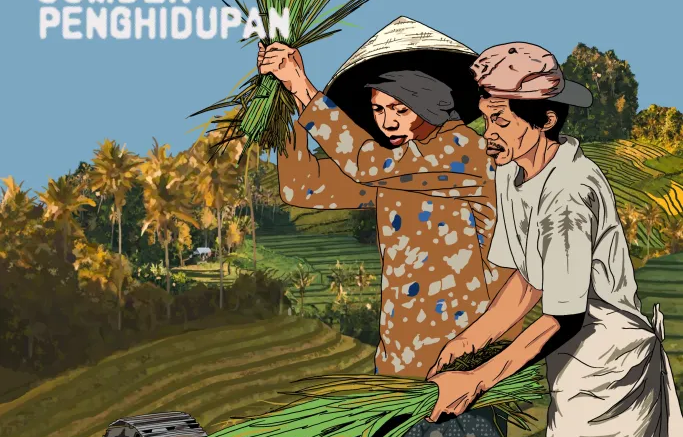
Territories for Climate Justice
By Nyeleni
Agrarian reform and redistribution must be at the heart of climate policies
Placing land and territories under the control of small-scale food producers, Indigenous Peoples, and rural communities is one of the most effective strategies to advance climate justice. Secure and equitable tenure is directly linked to ecologically sound resource management of territories, sustainable food systems, social justice, peace and well-being. Without redistributive policies, the concentration of land and resources will continue to fuel ecological destruction and deepen inequality.
Land inequality plays a central yet under-recognized role in the triple environmental crisis of climate change, biodiversity loss, and pollution. Today, just 1% of farms control 70% of global farmland, while the majority of rural communities, Indigenous Peoples, and small-scale food providers face dispossession and violence.
This not only undermines their human rights but also weakens their proven capacity to act as stewards of ecosystems. Territories under their governance consistently show lower deforestation rates, higher biodiversity, better water management and stronger climate resilience.
Since the 2008 financial crisis, land has increasingly been treated as a financial asset, leading to speculation, large-scale acquisitions, and displacement of communities. More recently, “green grabs” tied to carbon offsets and biodiversity markets have accelerated, with such schemes now representing 20% of large land deals.
These initiatives, marketed as climate solutions, often dispossess communities and erode ecological stewardship. Meanwhile, corporate, industrial food systems – dependent on monocultures, fossil fuels, and agrochemicals – remain major drivers of greenhouse gas emissions, deforestation, and soil and water degradation.
In contrast, small-scale producers – who use only 35% of global cropland yet feed more than half the world’s population – practice diverse, agroecological farming systems that enhance resilience and reduce emissions.
Their contribution is indispensable for climate adaptation, biodiversity conservation, and food sovereignty. However, their ability to continue this role depends on secure rights to land, water, and territories.
The question of who owns and controls land is thus inseparable from the challenge of building a just and sustainable future for all poeples. Addressing land inequality through redistributive tenure policies is not only a human rights obligation of states but also a social and ecological necessity.
Agrarian reform can stop and reverse land grabbing, curb inequality, strengthen community-based conservation, and enable just transitions toward agroecology and sustainable food systems.
Special emphasis needs to be put on measures to ensure the respect, protection and fulfilment of the rights of peasants and other small-scale food providers, Indigenous Peoples, and rural communities in the context of carbon and biodiversity markets.
In sum, placing land under the control of rural people and communities and securing their existing tenure rights – in particular collective and customary rights – lays the foundation for just transitions to sustainable and equitable economic models and societies.
Greening through data but data can’t be green
While the movements for food, agricultural and climate justice want to sync their struggles towards system change, carbon markets blossom with digital tools and processes: finding information, making calculations, programing a productive activity, transmitting information across seas or automating the nurseries—among others—, and they appear as frictionless, precise and clean.
Under the new digital world order, small and micro farms, community forests, and even backyards in peasant homes can enter the carbon markets as their capacity for CO2 sequestration can be calculated and auctioned.
Satellite measurements, precision agriculture with sensors in fields and forests, increased connectivity, widespread use of smartphones and tablets, modeling with artificial intelligence, increased robotization and automation in factories—these are some of the deployments that corporations hope to scale up as part of their efforts to offset their emissions.
This would be combined with the payment of carbon credits, green and blue bonds, climate bonds, and other financial instruments to be discussed at COP30.
The boost that digitalization is giving to carbon markets must be denounced as the scam it is, a snake biting its own tail. Digital technologies can never be clean because they depend on fossil fuels to power data centers and gadgets, and require the most aggressive extractivism to obtain their materials.
Will we see large digital technology companies at COP30 looking to lure people in with compensations, while offering their tools to measure speculative emissions?
Agrarian reform, agroecology, and the struggle for climate justice
The climate crisis we face today is rooted in a long history of dispossession—where our peoples have been forced from their territories— and colonization whose legacy continues today in and the corporate control over our food systems.
The industrial agriculture model, which puts profit ahead of people and nature, has systematically destroyed biodiversity, polluted the planet, and worsened the climate crisis. Every year, we see this in extreme weather events, with the heaviest burden falling on those who work the land, fish the waters, and grow food for our communities.
To push back against this destructive corporate-led food system requires a fundamental shift in how we relate to land, water, commons and territories—and how control over them is shared.
Therefore, for peasants, Indigenous Peoples, fisherfolk, pastoralists, and all small-scale food producers and land workers, the fight for agrarian reform is central to the broader fight for climate justice. This is because, simply put, without peoples’ control over land, water, seeds, and territories, agroecology—the practice that heals the earth and supports communities—cannot be practiced.
Integral agrarian reform is thus more than just redistributing land. It’s about reclaiming the commons needed to build territories of care and economies based on solidarity.
This must happen through the democratic participation of those who produce and consume food. The agrarian reform called for by social movements like La Via Campesina is therefore a struggle for the material conditions that allow small-scale producers to live with dignity and grow food in harmony with nature, through agroecology.
Why agroecology?
Peasant agroecology rejects dependence on chemical inputs and corporate seeds. Instead, it nurtures biodiversity, conserves soil and water, and rebuilds lost or damaged ecosystems. It is a production model, a political vision and a way of life grounded in respect for Mother Earth and collective well-being of all.
By combining biodiversity, soil health, water conservation, and local knowledge, peasant agroecology builds resilient food systems that store carbon in soils and vegetation. These farms absorb significant carbon, helping reduce atmospheric CO₂.
Tree cover, crop diversity, and ecological balance revive the soil, restore the landscape and prevent erosion, while regulate regulating local climates, maintain moisture, prevent erosion, and cooling the earth both locally and globally.
Applied to fisheries and pastoralism, agroecology protects aquatic ecosystems, preserves biodiversity, and ensures fair access to resources. Pastoralists use mobility and rotational grazing to prevent desertification and maintain soil fertility.
The struggle for agrarian reform and agroecology must therefore advance hand in hand if we are to dismantle the corporate food system and achieve true social, economic and climate justice.
Nyeleni is an international movement for food sovereignty founded by La Via Campesina.
Source: nyeleni.org, October 21, 2025