
Louisiana v. Callais Decision
By SNCC Legacy Project
As veterans of the Civil Rights Movement, we are angered by the Supreme Court’s decision in Louisiana v. Callais.
In the 1960s we organized against the killings and brutality of white supremacists trying to stop Black people from voting. We know what it means to face the darkness and despair of the America envisioned by this decision. The destruction of the Voting Rights Act isn’t an aberration or a mistake. Carefully woven between Callais’ false claims of “progress” lies the roadmap for the next phase of a long, disciplined project to contain and roll back Black political power in the United States.
We say this as people who fought with determination and commitment for a future in which our communities would enjoy shared and equitable power. While we have yet to achieve the future we envisioned in our youth, we remain undeterred. First hollowed out in Shelby County v. Holder, then further weakened in Brnovich v. Democratic National Committee, the dismantling of the VRA is part of a larger grab for absolute power. Over 160 years since emancipation, we fight the precision of modern gerrymandering, where districts are drawn not to represent communities, but to neutralize them.
It’s in legislative maneuvers that override the will of the people — even after elections have been won. And it’s in the quiet, shameless actions of local power structures — like the effort now underway in Louisiana to eliminate the important position of Criminal District Court Clerk in New Orleans, after the first Black person was overwhelmingly elected to that position.
White supremacy has never depended on a single tactic. Rather, it adapts, innovates, and learns. And too often, it counts on us to treat each new attack as if it were isolated. We’ve seen this before. And because we’ve seen it, we’re not confused about what this moment requires—Courage, radical imagination, and readiness to act.
Every time Black people move closer to power, agents of white supremacy bend themselves into new shapes. As a people, we’ve always known that changing the American status quo required sustained organizing and an agenda focused on real freedom. As a people, we have never known peace in our pursuit of fairness and justice.
Our communities have endured political violence even under the watchful eye of the federal government during Reconstruction. The decades that followed unleashed a reign of terror and administrative hypocrisy, including literacy tests and poll taxes. And more violence.
Despite the passage of the VRA, our communities faced new tests and burdens in the form of allegedly “neutral” laws. But there has never been anything neutral about obstructing the right to vote and denying political empowerment. A lesson from Callais is that we cannot look away. The names change, the language evolves, but the objective remains the same: Control the vote. Control the outcome. Control the future.
We understand this pattern from our years of experience. The alarm we sound today echoes past statements encouraging new generations of organizers and concerned citizens to take up the fight.
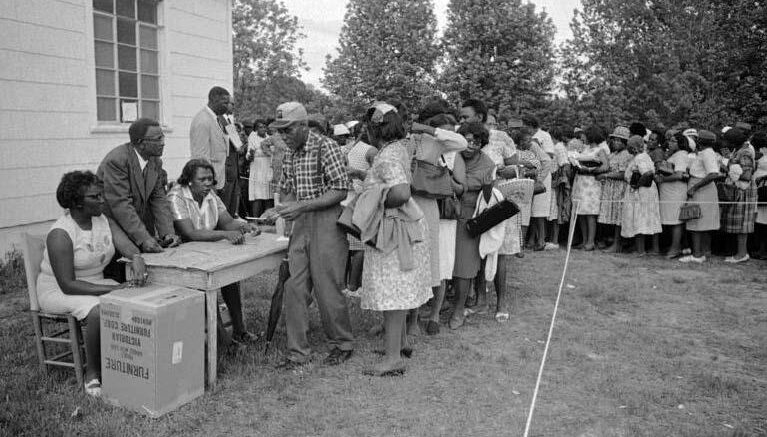
SNCC grassroots organizing
There is a reason people still ask those of us who were forged by SNCC’s organizing:
1) How did you organize under those conditions?
2) How do you keep going?
Because the conditions weren’t better back then, but they were clearer. There were no illusions about the system we were confronting. No expectation that the courts would save us. No belief that progress, once won, would be permanent.
We organized, knowing that every gain would be contested. We built, knowing that everything we built could be attacked. We acted, knowing that the opposition was coordinated, patient, and relentless.
And so, we became the same. We built deep relationships — county by county, block by block. We helped develop leadership among everyday people — not just professional elites. We created structures that could hold under pressure — not just moments that could go viral. We didn’t confuse visibility with power. We didn’t confuse access with victory. We didn’t confuse participation with control. That clarity is required again.
In a letter to Angela Davis, James Baldwin once wrote, “If they take you in the morning, they will come for us that night.”
Baldwin’s words still ring true today. As we’ve seen with ICE raids and the occupation of entire communities, no community is safe in isolation. We are in this together. An attack on Black political power isn’t a single-community issue. It’s a signal both of what is possible and what is coming.
Reflecting on our collective decades of experience, we reject the temptation to declare that everything is lost. We have seen darker nights than this one. But we do not pretend that this moment is ordinary. Yes, it is late, and it’s dark outside. But it is 3 a.m. This is the hour when the body is most vulnerable. The hour when the future feels uncertain. The hour when many lose their way.
It is also the hour before dawn. While justified, outrage alone won’t meet this moment. A new world isn’t guaranteed. But it is possible. And it’s already being imagined, organized, and fought for. What is required now is a return to disciplined, strategic organizing rooted in a clear understanding of what we’re facing.
Here is our humble suggestion to the movement for a way forward:
1) We must build and defend multi-racial coalitions
The forces behind decisions like Callais understand something fundamental: their power depends on division. So, our focus must be on building strong coalitions focused on common needs: housing, wages, healthcare, education, safety, and dignity. We need coalitions strong enough to withstand not only external attack but internal strain.
2) We must invest in local, durable power
National attention rises and falls. Local power decides outcomes. Courts can redraw maps, but they can’t easily dismantle relationships rooted in place. We must organize where we live. We must build infrastructure that doesn’t disappear after elections. And we must treat local offices not as mere steppingstones, but as sites of real power, because ultimately, they are.
3) We must understand the limits of the vote
without abandoning it
Voting remains essential. But voting alone has never been sufficient. We must protect the vote while also building power beyond it that can challenge unjust laws, resist administrative sabotage, hold officials accountable beyond election cycles, and mobilize people even when the system narrows their options.
4) We must prepare for coordinated opposition
What we’re facing isn’t random. From courts to legislatures to local administrative bodies, there is alignment. We must respond with the same level of coordination because these aren’t isolated fights, but connected ones.
It’s become abundantly clear to us what must come next. We must flank and sustain an organized resistance that builds with people in communities across the country. Callais makes clear the urgency of this moment and demands our participation in electing a Congress this November that will act. A Congress willing to impeach where necessary and remove those who undermine the Constitution.
Those seeking our support must commit to passing federal protections that restore and expand the right to vote and other pro-democracy reforms aimed at meaningful representation, like D.C. statehood.
In its current form, the John Lewis Voting Rights Advancement Act, which many know as H.R. 1, is a necessary step forward in repairing what has been deliberately dismantled. This is the floor, not the ceiling, of what justice requires.
As SNCC veterans, we know that legislation doesn’t move because it’s right. It moves because people organize to make it unavoidable.
The Struggle Continues!
The SNCC Legacy Project Digital Movement Platform tells its history and aims to motivate people toward the future through bridging generations.
Source: sncclegacyproject.org, May 8, 2026