
Commentary by Brian Palmer
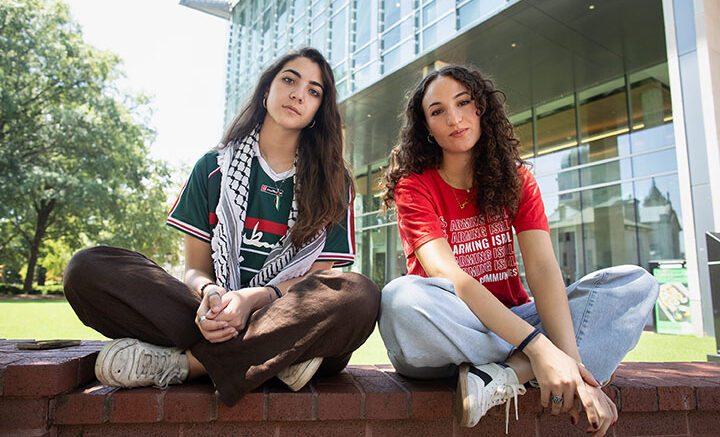
Sereen Haddad, a Virginia Commonwealth University psychology major, won a major battle against her school in July. But the war she’s fighting is far from over.
Haddad’s victory came on July 28 when VCU emailed to tell her that she would finally be getting the degree the school had withheld from her for 82 days.
This spring VCU had found the 20-year-old Haddad “responsible” for violations of the school’s expression and “space utilization” policies when she “attended and acted in a leadership role for an unauthorized event” on April 29, 2025.
VCU’s decision is a major, yet very quiet and bureaucratic about-face. It avoids countercharges by the students—and many of the school’s own professors—that it selectively enforces policies in order to chill, or eliminate, politically unpopular speech. And it also ignores the reasons Haddad and other students, like her classmate Selma Ait-Bella, had gathered this spring. They were commemorating April 29, 2024, the day police from three different forces stormed the campus to break up encampments that students had built to call attention to the killing of Palestinians in Gaza by Israel’s armed forces, the U.S.’s material and political support for Israel, and VCU’s investments in companies that do business with Israel.
Clearly, this story is bigger than VCU or Richmond, said Sam Freedman, a former Columbia Journalism School professor and a former education columnist for The New York Times.
“You have to wonder if VCU is feeling the pressure of Governor Youngkin’s attacks, through his appointees to the boards of the state’s public universities. He’s already driven out the president of UVA and is putting enormous pressure on the president of George Mason,” Freedman said. “And, along with DEI initiatives, pro-Palestinian protests have been a key target of MAGA. So it could be that VCU, as a public university, was either getting pressure already from the governor and his appointees or chose to ‘obey in advance,’ as the phrase goes, in order to be spared pressure down the road. Though giving in to a bully never works.”
VCU did not accept an interview request from me, citing the “student privacy under federal and state law,” but issued a general statement repeating the charge against Haddad. After VCU dropped the charge I asked again for comment. “Privacy laws prevent us from discussing the conduct process involving a specific student.”
To get her degree, VCU administrators had given Haddad three options. She chose option three: confront her accusers.
Haddad made her case on July 22 in a virtual hearing with VCU administrators, faculty, staff, and a student representative, according to Haddad and Professor Glenn Hurlbert who served as witness.
Hurlbert, a professor of mathematics and member of VCU’s faculty senate, told me he spent roughly half an hour pointing out the fundamental flaws in the school’s case. “The technical issues are essentially the important part,” Hurlbert said, which allow “the dismantling of that kind of argument. And that’s where my mathematical expertise comes in.”
One hole was the lack of clear definition in any university policy of the term “unauthorized event”—or even “event” itself.
“They define the word ‘event’ as, ‘an assembly, or organized expressive activity,’” which “actually involves everything that two humans do together,” Hurlbert said.
“This has never been specifically about, I want my degree,” Haddad told me. “It’s more so about what kind of disturbing message VCU sends that they can implement these kind of actions and take action against people who are protesting a genocide.”
Ait-Bella, like several other protesters for Palestinian rights, also had her degree withheld, too, but she settled with the university before graduation and received the diploma. To get her sheepskin, Ait-Bella had to write an essay. The assignment from VCU: address one requirement of university policy, specifically highlighting what “benefits this requirement might offer the University and/or its students and the importance of complying with the policy.”
Forty years ago, when I was Ait-Bella and Haddad’s age, I was an exchange student in the People’s Republic of China. In the mid/late-1990s I moved to Beijing and worked as a magazine bureau chief for roughly two years. VCU’s assignment sounded suspiciously like Maoist self-criticism, a psycho-political process designed by the Party to compel a dissenter to resubjugate herself, publicly, to its dictates. The public part of this matters: you disavow your beliefs before your peers, thereby destroying your credibility and undermining your cause without the powers that be having to flex.
Ait-Bella responded by turning the process on its figurative head.
“It is clear that policy functions as a tool to justify political repression,” Ait-Bella wrote. “I think genocide is unreasonable and indefensible.” She received no reply from VCU.
Neither Ait-Bella or Haddad use the term genocide lightly. More than 200 of Haddad’s family members have been killed in the war on Gaza, her father, Tariq, said when they appeared on Democracy Now in July.
Since the October 7 attack by Hamas, Israel has responded with disproportionate and indiscriminate force, according to international humanitarian law experts and aid providers, medical personnel, dissenting Israelis, and Palestinians themselves. Hundreds of thousands of civilians have been wounded or killed in Gaza. Israeli settlers kill Palestinian farmers and filmmakers in the West Bank with impunity. And the casualty numbers rise steadily, as the Israeli military continues its attacks and the government blocks most aid bound for Gaza, leading to mass starvation.
Israel’s Prime Minister, Benjamin Netanyahu, denies Gazans are starving or that Israel is preventing aid from reaching that occupied territory. And, he said last year: “The charge of genocide leveled against Israel is not only false, it’s outrageous, and decent people everywhere should reject it.”
History shows that Americans have a habit of privileging Israeli voices and ignoring Palestinian ones—from the late Edward Said and Diana Buttu, to deeply credible newcomers like Tareq Abou Azzum. He’s a young Al Jazeera correspondent I’ve been watching closely. Abou Azzum has been filing clear and substantive reports from Gaza month after month, day and night. And he and his peers continue to report, even as they scrounge for food to eat, and even as they are targeted by the occupation forces.
While American corporate media shrink before the G-term—and the abundant evidence of it—prominent genocide and Holocaust experts use it to describe Israel’s project. Stockton University’s Raz Segal, writing in Jewish Currents, called Israel’s post 10/7 actions a “textbook case of genocide unfolding before our eyes.” Brown University’s Omer Bartov, an Israeli by birth who served in that nation’s military, wrote a piece for the New York Times headlined “I’m a Genocide Scholar. I Know It When I See It.” And just last week, two of Israel’s main human rights organizations, B-Tselem and Physicians for Human Rights Israel, charged their own government with genocide against Palestinians. The title of B-Tselem’s report? Our Genocide.
“I have learned that educating the public about a genocide disrupts the school’s academic mission,” Ait-Bella wrote in her nonself-criticism, “because the real mission is to create the next engineers who will build the weapons of future wars, the political science students who will sign off on those wars from their elected seats, and the journalism students who will write off this genocide as an unavoidable ‘conflict.’”
“Virginia’s crackdown exists within the nationwide context of Trump’s punishment of major universities—all on the very dubious pretext of fighting antisemitism,” Sam Freedman told me.
“What’s really going on nationally is an effort to use financial leverage, legal leverage, and threats of loss of accreditation, to make universities take their marching orders from the White House,” Freedman said. “Turning any form of pro-Palestinian activism—however nonviolent—into forbidden behavior is very much part of the MAGA program.” Freedman was on Columbia’s faculty—and on campus—during Columbia’s Palestine protests.
After she got the good news about her degree, she texted me. “I want to be clear that this was not VCU choosing to do the right thing or them waking up and realizing they had erred,” Haddad said. “This was the result of pressure and of a case they couldn’t defend, because of our evidence and because the truth was always on our side and they were left with no choice.
“I may be getting my degree now—but I never needed it to speak truth, to stand for justice, or to defend my people.”
Haddad closed her message with “all eyes on Gaza.”
Brian Palmer is a Peabody Award-winning, Richmond, VA-based journalist.
Source: substack.com/@bxpnyc, July 30, 2025