
Commentary by Michael D. Yates
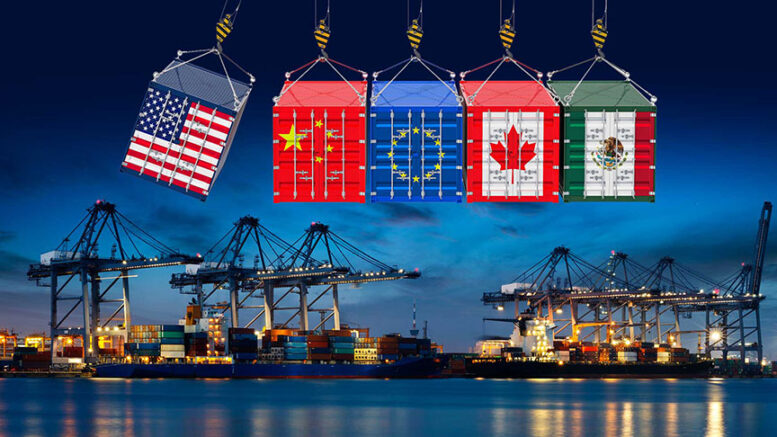
A cornerstone of Donald Trump’s economic policies is tariffs. Claiming that just about every country in the world has ripped off the United States—even stating that the European Union was established to do this—he sees tariffs as a way for the U.S. to get even. Playing up the anti-Chinese propaganda that is now the stock in trade of Republicans, Democrats, and the mainstream media, he says that China is the worst abuser of America and so deserving of the highest tariffs.
He claims, with no evidence, that tariffs will not only bring in trillions of dollars in revenue but also reinvigorate manufacturing industries through import substitution. He may or may not grasp the fact that if the latter goal is achieved, little revenue will be forthcoming, as there would then be few imports to tax.
The rollout of the tariffs has been haphazard, with Trump’s mercurial reversals, bombast, and lies generating anxiety among business leaders and financial talking heads. Fears of both recession and inflation, with resulting unemployment and lower capital spending, are now widespread. But despite the serious economic downsides of the Trump tariffs, they have been supported by numerous labor unions and some left thinkers and activists.
Trump has convinced many of his followers that the tariffs he is imposing, with his authority to do so coming from the International Emergency Economic Powers Act (IEEPA) of 1977, are paid by the countries against whose products the tariffs are imposed. This is not true. When a tariffed good enters a port of entry in the United States, customs inspectors collect the duty from the importer, a U.S. company. A product priced at $1,000 with a tariff of 10 percent will thus cost the importing company an additional $100 per unit imported. The importing company will then try to pass this extra cost onto consumers, as is the case with any sales tax. Its ability to do so will vary, but studies show that most of the tariff burden is ultimately paid by consumers.
This will reduce demand, output, and employment. And because working people spend a higher fraction of their incomes than those with higher incomes, tariffs are regressive, harming those lower down in the income distribution the most. If other countries retaliate, U.S. exports will fall, and this will also mean lower U.S. incomes, spending, and employment. For example, U.S. exports to China, which are now subject to high Chinese tariffs, account for nearly one million U.S. jobs and about $150 billion in total income.
Given these downsides, why would unions and left-leaning writers support them? Shawn Fain, reform president of the United Auto Workers (UAW), has championed Trump’s tariffs. On March 26, 2025, the union officially stated: “This afternoon, the Trump administration announced major tariffs on passenger cars and trucks entering the U.S. market, marking the beginning of the end of a thirty-plus year “free trade” disaster. This is a long-overdue shift away from a harmful economic framework that has devastated the working class and driven a race to the bottom across borders in the auto industry. It signals a return to policies that prioritize the workers who build this country—rather than the greed of ruthless corporations.”
“We applaud the Trump administration for stepping up to end the free trade disaster that has devastated working class communities for decades. Ending the race to the bottom in the auto industry starts with fixing our broken trade deals, and the Trump administration has made history with today’s actions,” said UAW President Shawn Fain.
Fain says that tariffs are “a tool in the toolbox…to bring jobs back here, and, you know, invest in the American workers.”
Fain does qualify this endorsement by saying that many other things have to happen as well, such as pro-labor NLRB decisions, protection of Social Security and Medicare, etc, none of which has the slightest chance of happening under Trump. Fain mentions the “free trade disaster,” referring to the North American Free Trade Agreement (NAFTA), enacted first by the Clinton administration; it took effect on January 1, 1994. This agreement was indeed a disaster for workers in all three signatory nations: the United States, Mexico, and Canada. However, Fain ignores the fact that tariffs will be a calamity for working-class communities as well. In fact, more than half of UAW members are not in the auto sector. What will Fain and the union do to protect these workers from the harmful effects of tariffs? And what if Trump one day decides to punish Stellantis (formerly Chrysler), which is headquartered in the Netherlands, while favoring Ford and General Motors. What then, brother Fain?
There are other unions that have voiced support for Trump’s tariffs, but rather than examine each one, I want to suggest a plan of attack for labor against the entire Trump program, which goes far beyond opposing the tariffs. We are facing a neofascist government, which plans to completely remake U.S. society in the image of something not unlike Hitler’s Germany. Labor needs to reject all of this administration’s fascist-like efforts, including the tariffs, which are part of a larger repressive program.
There is nothing in this government’s present and likely future actions that supports working people. Quite the contrary. Thousands of federal workers have been fired, with false charges they were unproductive or hired because they were women or minorities. Undocumented workers now live in fear as they are dragged off the streets and put in prison in the United States or sent to hellhole gulags in El Salvador. Immigrants are told they have to self-deport, including immigration attorneys. The children of immigrants, some as young as two have been deported.
College students, who are either working or are future workers are targeted for opposing genocide, often with the full complicity of college administrators. They have been attacked by Israeli operatives, doxxed with the resulting personal attacks and violence, and blacklisted so they won’t be hired after graduation. Medicaid is being cut, and nearly two-thirds of recipients work full- or part-time, while those who don’t work for wages but are caretakers of children and parents are surely part of the working class.
Similar reductions are planned for Medicare and Social Security, which will negatively affect retired workers and the significant share of the elderly who are still working. The massive cuts in federal education spending directly and negatively impact educators and support staff, along with the kids who will soon enough be workers (already states are allowing children as young as twelve to work in dangerous occupations).
Trump’s NLRB appointees (following dismissals), along with those in the Department of Labor, are and will be making anti-labor decisions, as will the Supreme Court. Trump has already ended collective bargaining for federal workers he claims are critical to national security, including 50,000 TSA (Transportation Security Administration) agents.
Cuts begun at Health and Human Services, now headed by health quack Robert Kennedy, Jr., not only will result in unemployed health workers but the policies he wants to implement will make workers sick or kill them. The enormous increase in military spending will lead to more cuts in social welfare spending and will sharply increase the risk of wars, both directly and negatively affecting working people.
The enormous regressive tax cut now in the works will further increase inequality, reducing consumer spending among those with the lowest incomes and at the same time making workers less physically and mentally healthy. We have already pointed out how the tariffs will harm workers.
In the face of all of this, there are many things organized labor can and should do:
1. Join in the ongoing demonstrations now taking place throughout the United States. Organize labor-centered demonstrations like the one planned for May Day in Oahu.
2. Target specific members of the Trump administration, his Supreme Court advocates, members of Congress, local sheriffs and police departments, and all those employers who have bowed down to Trump for informational picketing. Give these actions widespread publicity and invite the general public to join.
3. Continue to file lawsuits against illegal firings, deportations, and executive orders.
4. Call one-day work stoppages in as many places as possible, building to more general strikes.
5. Protect vulnerable workers through collective bargaining negotiations and refuse to give up contract provisions that now offer such protections. This might be especially effective on college campuses where there are now unions of faculty, staff, and student-workers. The UAW and the USW have many members in higher education now. (The USW has recently organized nearly every worker at the University of Pittsburgh).
Support anti-Israeli genocide protests on campuses. And make opposition to genocide a union principle. Unions have Palestinian- and Arab-American members. Protect them. And they have undocumented members as well. Don’t allow employers to give in to government pressures to identify and prosecute them.
6. Begin to educate members on how to resist any and all illegal actions against members. Reach out to all workers in doing this.
7. Never throw workers from other countries under the bus. We have a global economy, and international solidarity is important. Actions that benefit a few U.S. workers at the expense of workers in other parts of the world won’t be forgotten, to the detriment of the U.S. working class.
8. Those laboring on the nation’s docks but enjoying union protection should refuse to handle military cargo headed to Israel. All unions should stand firmly against genocide. None of these measures will likely stop Trump. A comprehensive, longer-term strategy will be necessary. Organized labor in the United States is weak, notwithstanding the pronouncements of the social democratic left to the contrary.
Organized labor is not enjoying a rebirth. There have been a few successful organizing campaigns and strikes, but union density, major strikes, and labor’s political power are at historically low levels. These trends could be reversed, though I doubt they will be any time soon. However, at least two things could be done:
1. Teach workers how to organize. Labor stalwart Chris Townsend helps to run the Inside Organizer School in Northern Virginia (there are sessions of the school elsewhere too), where there has been a striking rise in union membership. Young workers learn how to organize, using the works of William Z. Foster and others as guides. They are trained to “salt” nonunion workplaces, that is, get hired and then agitate for a union. The Institute then offers support, sometimes even including housing. Chris’s efforts were critical in the organizing of hundreds of Starbucks stores. There is no reason why labor unions and workers’ centers cannot do the same.
2. Begin to educate union members and all workers in a systematic way. There are labor studies programs at various colleges and universities that do this, but there are not enough of them. Unions must also educate their members, not just about filing grievances and other everyday necessities but general education in labor history, politics, and political economy. Few unions do this, and this is one reason why their members don’t have a working-class outlook on life. Instead, they are apathetic politically or vote against their own interests.
More than 40 percent of households with a union member who went to the polls voted for Donald Trump last year (though 57 percent voted for Kamala Harris, a larger percentage than for Biden). Worker Centers, some independent and some affiliated with labor unions, do offer worker education (The Chinese Staff and Workers Association in New York City does.), but there must be many more of these, along with labor colleges such as the one established in Minneapolis.
3. Organized labor in the United States collectively has about $35 billion in assets. Why not use some of this money to set up worker education centers in every medium-sized and larger town in the country? Have a space where any worker can come and make a complaint about a workplace. Hold short meetings and classes, offered at convenient times and give these wide publicity. Have special events for specific groups of workers, for example, those who work in restaurants. Have a library with books and magazines geared to workers.
Federal workers now getting fired and the academic community are facing increasing threats and losing funding. The terrorized immigrants for whom union membership might offer some hope of support, and the great numbers of unorganized workers who shall face increasing pressure in their lives as tariff-influenced inflation takes hold, and who rely on scant and decreasing Federal benefits (such as food stamps) offer a vast opportunity for imaginative organizing.
It is an illusion that these government funds and the existing limited power of U.S. unions can be maintained unimpaired as the neofascist offensive unfolds. Where union power is concerned, it is a case as in so many other areas of use it or lose it.
Michael D. Yates is author of numerous books on unions, conditions in the working class, and the labor process.
Source: mronline.org, May 01, 2025. A longer version of this article is available on the Monthly Review website.