
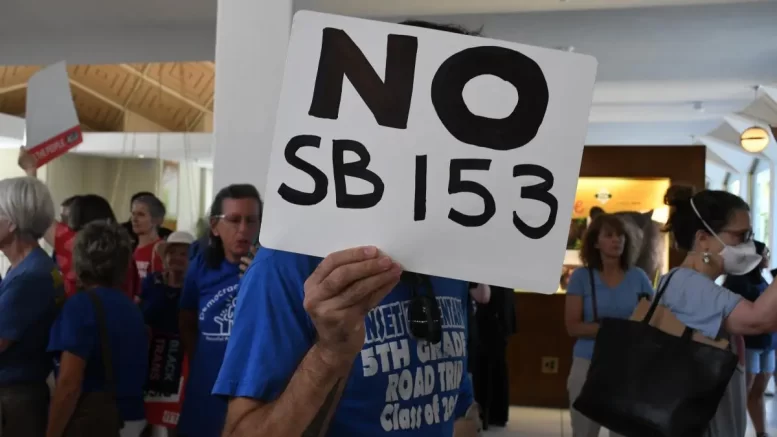
SB 153 (NC Border Protection Act) has taken effect, but how will it be enforced?
By Emilia Rivadeneira
Although the law took effect immediately after its approval on June 24, some of its provisions—including the requirement that four state agencies sign 287(g) agreements with ICE—have implementation deadlines that have already passed.
The American Civil Liberties Union of North Carolina (ACLU NC), expressed concern over the enactment of Senate Bill 153, known as the North Carolina Border Protection Act, after lawmakers in the General Assembly overrode Gov. Josh Stein’s veto on June 24.
In a statement, the organization said that, by doing so, lawmakers ignored documented abuses by U.S. Immigration and Customs Enforcement (ICE) and the harm that, it said, the agency has caused to communities across the state.
“At a time when federal immigration agencies are facing growing bipartisan calls for transparency and accountability, our lawmakers have made it clear that blatant civil rights violations are not reason enough to rein in ICE,” the group said.
“SB 153 deepens the state’s complicity with a system that spreads fear, confusion, and harm by expanding the reach of immigration agencies that operate recklessly and giving the green light to more abuses in our communities,” it added.
Sammy Salkin, senior policy strategist at ACLU NC, told Enlace Latino NC that the law not only expands the involvement of state agencies in the federal deportation agenda, but also reinforces a narrative that criminalizes immigrants in North Carolina, causing fear and uncertainty.
“It is simply another attempt to make our immigrant neighbors here in North Carolina into scapegoats and criminalize them,” Salkin said.
Uncertainty Over the Implementation of SB 153
Although the law took effect immediately after its approval on June 24, some of its provisions, including the requirement that four state agencies sign 287(g) agreements with ICE, have implementation deadlines that have already passed.
Enlace Latino NC asked North Carolina House Speaker Destin Hall when the Highway Patrol would sign the 287(g) agreement it is required to enter into with ICE.
“I imagine as soon as they can reasonably get it organized,” Hall responded. He then added that it will depend on any memorandum of understanding (MOU) that both parties agree to sign.
Salkin explained that 287(g) agreements are not drafted, signed, or implemented overnight.
“These are agreements that have to be negotiated between law enforcement agencies and the federal government. So, in practice, this is not going to happen immediately,” Salkin said.
Salkin added that because it is still unclear when the agreements will be signed, when they will be made public, or when they will take effect, implementation remains a complicated and confusing issue.
“That is a complicated and confusing aspect: technically, the law is already in effect. However, in practice, none of this can happen overnight,” she said. “It will take time to determine exactly what these agreements will look like.”
For Salkin, the biggest question therefore concerns those agreements: when they will begin to be implemented, how they will work in practice, and what exactly they will contain.
Salkin said it is understandable that immigrant communities feel afraid following the enactment of SB 153.
“That is precisely the purpose of this law: to instill fear,” she said.
Enlace reporter Emilia Rivadeneira graduated with a double major in Political Science and Communication from NC State University, with an interest in community-focused journalism.
Source: Enlace Latino NC, June 30, 2026