
Our Unhoused Neighbors?
Commentary by Rayna Rusenko
I have strong views regarding how the city of Durham treats people experiencing homelessness. I have vocally advocated for HEART and its expansion since 2022, precisely because it has a unique capacity to connect folks with needed resources.
For these reasons, I am perhaps more swayed by emotion than many Durham residents when confronted with the fact that my city has been conducting park clearances—and that, in sweeps through April, the Durham Community Safety Department (DCSD) had placed itself at the front lines.
While I’m disappointed by DCSD’s choices, I want to stress that the root of the problem is within the city government as a whole, and can ultimately be traced to an order signed by the city manager. Multiple departments in the city government–from the City Manager’s Office (CMO) and Parks and Recreation to the Community Safety Department and DPD–worked together to plan and enact these clearances.
And, I am further concerned because, just this year, the city government appears to be making plans to further close encampments throughout Durham. In practice, this means forcibly displacing people with nowhere to go, destroying what little they have, and effectively normalizing–and potentially escalating–violence against them.
From a policy perspective, the only just way of addressing homelessness is to ensure people are given better options–and never to take away what little they have. Durham should be doing more to humanely attend to our neighbors’ needs.
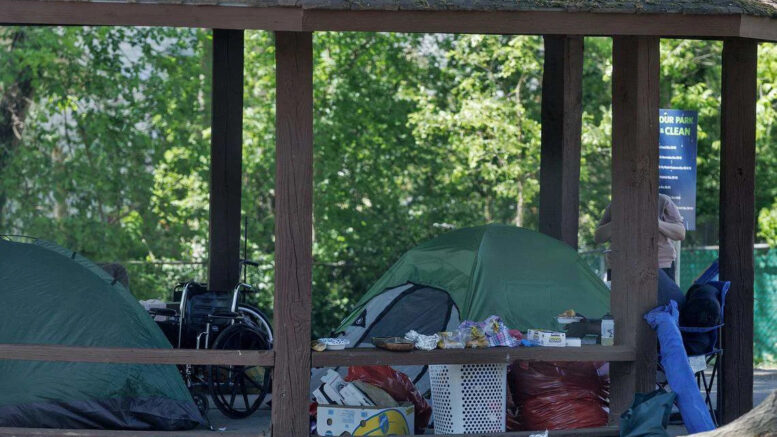
I was present at two attempted clearances at Oakwood Park in April, the second of which gained attention through an N&O article published on April 16th. From what I’ve seen, at clearances, HEART staff approach unhoused neighbors to inform them that the city has ordered them to leave, and offer to carry or store the belongings of people who cooperate.
Then, other city workers seize all property remaining in the park, including those of absent neighbors, and immediately dispose of them in garbage trucks. Throughout, DPD officers stood by in large numbers, their presence a clear signal that any refusal to cooperate could lead to arrest.
During the clearance, Police Chief Andrews told me that DPD was at Oakwood Park to support DCSD. Public information shows that while DCSD did act in a coordinating role for the sweep’s interdepartmental work-team, the operation was initiated under pressure from the CMO—not at DCSD’s behest.
I include the Police Chief’s statement here, however, because it does illustrate well how the city can strategically use HEART teams—visually and rhetorically—as a shield to make brutal policy decisions appear kinder and more compassionate.
This is one among many reasons why I feel so strongly that HEART should not place itself at the frontlines.
Many Durhamites are unhappy with HEART’s characterization as un-empathetic for their role in clearances—with one defense being that HEART sought to reduce harm in light of an inevitable sweep. That is, their intent may have been good.
However, HEART staff saw that the impact of their role was devastating to the people they wish to be in relationship with; to collaborate with actors (the city, in this case) at the root of an immediate crisis will necessarily undermine their ability to “increase stability for our neighbors facing crises” (HEART’s stated aim).
People lost medication and treasured possessions, among other things, and suffered the indignity of being treated as a problem, outnumbered and surrounded by city staff and city vehicles.
HEART, as an institution, unfortunately lent its power to facilitate—rather than challenge—the city’s very troubling decision to move forward with clearances. These ongoing clearances are displacing and further immiserating unhoused persons, making life less stable and less safe.
Also, we must remember: clearances normalize violence against unhoused persons. By any metric, these sweeps are not an acceptable status quo.
From the N&O’s article of April 16th, I understand some city residents might argue that living in a tent or on the streets is itself inhumane, and therefore not a state worth protecting. While I agree each person deserves far better, that means Durham should be doing more to ensure they have better options—not depriving them of what little they have.
I want to stress here that a tent is also a shelter, a trusted space among trusted people is an invaluable resource, and humanity exists wherever people do.
Homelessness is, by definition, not having guaranteed access to private property—and this constrains people’s ability to sleep, eat, bathe, avoid the elements, and perform other life-sustaining activities.
Jeremy Waldron’s “Homelessness and the Issue of Freedom” provides fantastic insight into these and other questions surrounding homelessness in public spaces.
Under no circumstances should the city of Durham be impinging on people’s ability to survive through the use of public resources when that is all they have.
In fact, we should be ensuring they have access to far more of the critical resources they need.
Rayna Rusenko is a sociologist of homelessness and public policy.