
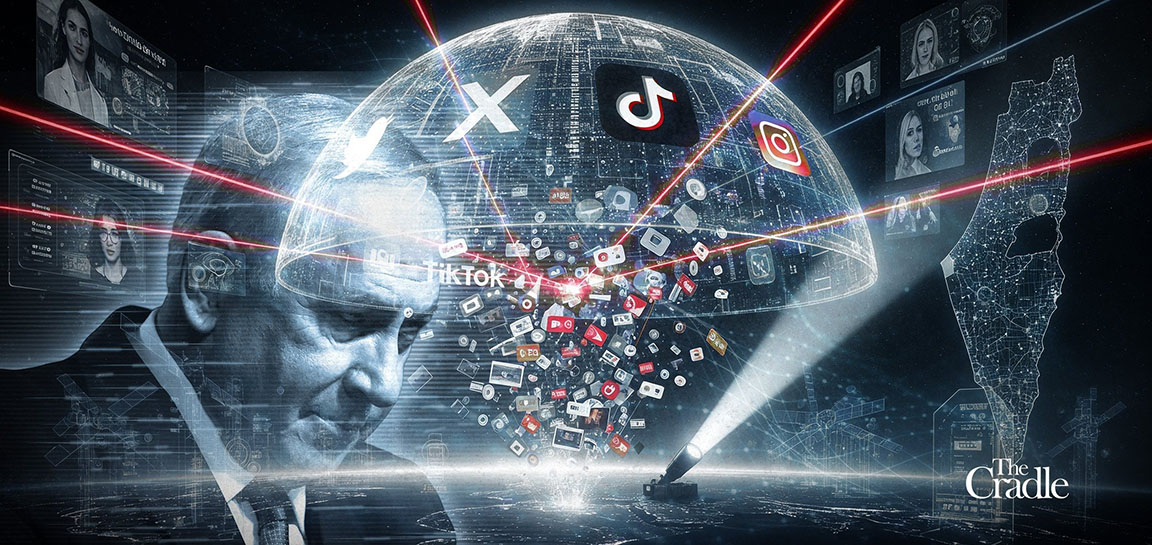
Israel’s digital Iron Dome and the narrative battle
By Mohamad Hasan Sweidan
Israeli Prime Minister Benjamin Netanyahu has described the “Eighth Front” of his war as the battle over truth. “Seven fronts against Iran and its proxies. The eighth: the battle for the truth,” he said during a ceremony hosted by US network Newsmax at Jerusalem’s Waldorf Astoria hotel.
Its aim is to refute accusations of genocide and deliberate famine linked to Israel’s two-year-long war on the strip, with social media and artificial intelligence (AI) programs serving as the most important battlegrounds on this front.
Digital Iron Dome
In the wake of Operation Al-Aqsa Flood on 7 October 2023, Israel’s so-called “Digital Iron Dome” was activated to intercept digital content just as its military dome intercepts missiles. But instead of shrapnel, the targets are ideas—posts, images, videos—that expose Israel’s atrocities in the besieged enclave.
This digital dome operates on two main layers. First is the volunteer-driven reporting system: a nationwide campaign in which users flood social media platforms with mass complaints against content deemed unfavorable to Israel. A hybrid of AI and human reviewers rapidly classifies flagged posts, then pushes takedown requests to platforms like Meta, TikTok, and X. The goal is speed—to kill the narrative before it spreads.
TikTok alone deleted 3.1 million videos and cut off 140,000 live streams in the first six months of Israel’s genocide in Gaza. The Israeli Attorney General’s Cyber Unit filed nearly 9,500 takedown requests during the same period, with Meta allegedly complying 94 percent of the time.
The second layer is algorithmic warfare: AI systems scan over 200,000 websites to identify dissenting narratives, then bombard exposed users with paid pro-Israel content in real time. Using ad campaigns that mimic the look and timing of organic posts, Israel floods timelines with a manufactured counter-narrative.
This dual strategy aims to overwhelm and erase. The first suppresses the spread of resistance voices. The second replaces them with state-approved fabrications.
On 26 September 2025, Netanyahu met with 18 US-based social media influencers. The directive was to flood TikTok, X, YouTube, and podcasts with pro-Israel messaging. A week later, Tel Aviv allocated $145 million to its largest-ever digital propaganda campaign, dubbed “Project 545.” The campaign targets US public opinion, especially Gen Z, with AI-assisted content tailored for TikTok and Instagram.
Documents from the US Foreign Agents Registration Act (FARA) reveal that the Israeli Foreign Ministry contracted with Clock Tower, a firm headed by US President Donald Trump’s former campaign manager, Brad Parscale. The aim is to influence both public discourse and the responses generated by AI platforms like ChatGPT, Grok, and Gemini.
In parallel, the “Esther Project” was launched to bankroll US influencers with contracts reportedly reaching $900,000 per person. These influencers are expected to post 25–30 times a month, creating a constant stream of pro-Israel content. Between June and November 2024, at least $900,000 in campaign payments were distributed to 14–18 influencers, with payments averaging $6,100–7,300 per post.
Bridge Partners, a company contracted with the Israeli Ministry of Foreign Affairs, sent a series of invoices for the costs of the campaign of pro-Israel “influencers” to the international media group “Havas Media Group” in Germany, which works for Israel.
Show Faith by Works, a new company established in July 2025, received $325,000 in just two months to promote Israeli propaganda among Christian communities in the US and west. With plans to spend as much as $4.1 million on the campaign, it has been billed as the “largest Christian Church Geofencing Campaign in US history.” Meanwhile, the Israeli Foreign Ministry injected an additional $137 million into global perception-shaping campaigns, on top of regular image-boosting programs.
These initiatives form part of a larger strategy often referred to as “hasbara”—a Hebrew term for Israel’s public diplomacy and propaganda efforts. In the digital era, hasbara has evolved from conventional media narratives into sophisticated AI-assisted influence operations designed to dominate and distort online discourse.
A report by Spain’s public broadcaster RTVE, citing an investigation by Eurovision News Spotlight, revealed that the Israeli government allocated roughly $50 million in ad spending across Google, X, and French-Israeli ad networks Outbrain and Teads.
The aim, according to the investigation, was to counter global reporting on the famine in Gaza by portraying a facade of normalcy. From January to early September 2025, Tel Aviv placed more than 4,000 digital ads—half of them targeting international audiences. These ads presented a sanitized Gaza, free of rubble and starvation.
Digitally laundering war crimes
The online war does not stop at public platforms. In May 2024, OpenAI revealed that it had dismantled five covert “influence operations” exploiting its tools—one of which was run by the Israeli company STOIC. The firm used large language models to generate pro-Israel content and anti-Hamas messaging tailored for US audiences, then deployed them via fake accounts across Facebook, X, and Instagram.
The New York Times (NYT) reported a parallel Israeli government operation that used nearly 600 fake accounts to flood the feeds of 128 US lawmakers with over 2,000 curated comments per week. These messages defended Israeli actions and smeared Palestinian institutions and the leading humanitarian aid provider in Gaza, the UN Relief and Works Agency for Palestine Refugees in the Near East (UNRWA).
Last year, UNRWA spokesperson Juliette Touma was quoted as saying:
“These ads are destructive to people. They should stop, and those responsible for this sabotage should be held accountable. There should be a lot of follow-up with companies like Google once the war is over. There’s a lot to answer to.”
Through these methods, Tel Aviv seeks to pre-empt and overwrite opposition narratives at the very moment they appear. The result is a digital space saturated with state propaganda—a timeline engineered to forget.
Exporting repression
The global danger lies in the model set by this precedent. When a colonial military power facing credible accusations of genocide can use digital tools to rewrite the record in real time, it sends a clear signal that anyone with the money and tech can do the same.
Israel’s system is simple but devastatingly effective: mass reporting to silence dissent, targeted ads to manipulate perception, influencer contracts to manufacture consent, and AI tools to distort the truth.
If this model spreads, resistance voices worldwide—from students to journalists to indigenous movements—will find their truths buried under a paid avalanche of state propaganda.
Tel Aviv may have pioneered this digital occupation of truth. But it won’t be the last to deploy it against those fighting for justice.
Mohamad Sweidan is a strategic studies researcher, a writer for different media platforms, and the author of several studies in the field of international relations.
Source: thecradle.co, October 10, 2025