
By Al Mayadeen English
Born from decades of occupation and digital warfare, Israeli AI surveillance tech could spread the same systems of control and repression far beyond occupied Palestine.
A new Israeli startup, Scanary, has unveiled an AI-powered security screening platform that it claims could revolutionize public safety at airports, stadiums, and transport hubs. But behind its polished narrative of efficiency and innovation lies a deeper concern: the expansion of Israeli occupation-linked surveillance technologies into global civilian life.
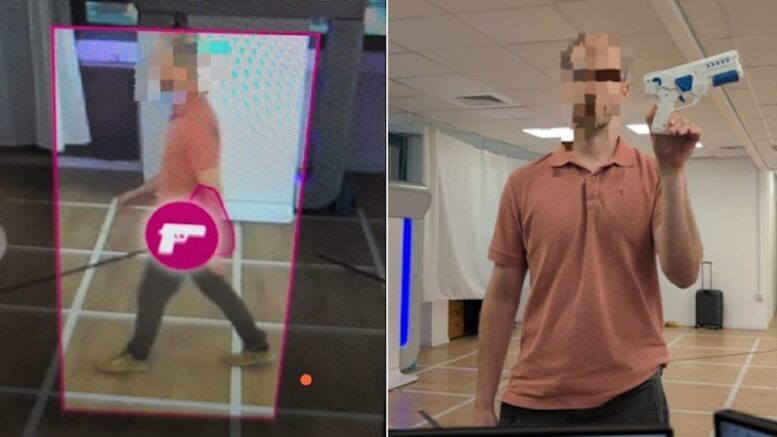
Scanary, dubbed the “all-seeing eye” and based in Tel Aviv, says its system can detect weapons and other threats without requiring people to stop or be physically screened, a “frictionless” process touted as safer and more convenient. The company claims the radar-based tech can scan up to 25,000 people per hour while protecting privacy.
What’s not advertised as openly is that Scanary’s origins lie in decades of counterinsurgency operations developed within the Israeli occupation’s security and military establishment, specifically, from tactics used to monitor and control Palestinians in occupied territories.
Founded by ex-Rafael engineer, Israeli AI draws from Gaza war tech
The startup was co-founded by Dr. Gideon Levita, former chief radar engineer at Rafael Advanced Defense Systems, the same military firm behind the Iron Dome and Trophy systems, used extensively in “Israel’s” ongoing genocide in Gaza.
It is worth mentioning that Israeli arms company Rafael may lose its EU grant funding after it posted a PR clip on the social media platform X showing the killing of a man in Gaza by its drone, the Spike Firefly.
Moreover, if any evidence of non-compliance emerges, necessary steps taken can include potentially reclaiming some or all of the funding granted, an EU Commission official told EUobserver.
Scanary’s CEO, Ronen Yashvitz, is a veteran of Unit 8200, the Israeli military’s notorious cyber-intelligence arm, which has long been implicated in surveillance of Palestinians and digital espionage across the region. He openly describes the company’s mission as one of disruption, eliminating conventional security checkpoints and replacing them with continuous, real-time scanning based on radar and AI.
Modus operandi
The system operates by placing dual radar sensors across a 200-square-meter zone, collecting 10 images per second per person. An AI-driven classification engine then identifies materials and flags potential threats, sending real-time alerts, complete with video and object-location data, to security personnel.
Though the company claims the system does not collect facial images or biometric data, critics argue that the normalization of such technology risks reinforcing a culture of total surveillance under the guise of security, particularly troubling when pioneered by companies deeply enmeshed in the Israeli occupation’s apparatus of control.
Scanary markets its product as ideal for stadiums, airports, and even US schools, pointing to its ability to detect pyrotechnics and weapons in crowds. But rights advocates warn that the expansion of these tools could facilitate the same repressive surveillance and racial profiling used against Palestinians, now applied to broader civilian populations under the banner of “safety”.
The company has already raised $3.5 million in seed funding and is preparing pilot deployments in Israeli airports and train stations, infrastructure historically tied to the militarization of daily life and control of movement within the occupation. Scanary is also seeking regulatory approval in the US, after securing CE and GDPR certifications in Europe.
Wider context
This comes as the global security screening market is projected to hit $13.8 billion by 2030. But experts warn that funneling this demand into unregulated or military-backed tech firms, especially those with records of occupying and surveilling an entire civilian population, risks exporting authoritarian practices under the veneer of innovation.
Scanary’s main US competitor, Evolv Technologies, has already faced scrutiny from the US Federal Trade Commission over misleading claims about its AI’s threat detection abilities. Similar concerns loom over Scanary, which has yet to conduct any public live demonstrations.
As Gaza remains under siege, with thousands killed in Israeli airstrikes and military operations increasingly driven by AI-enabled systems developed by firms like Rafael, the expansion of such surveillance technologies into international civilian spaces raises pressing ethical concerns. Critics warn that exporting tools born out of an occupation context and used extensively in war zones may normalize invasive surveillance under the guise of public safety.
Al Mayadeen is an Arab Independent Media Satellite Channel.
Source: english.almayadeen.net, July 25, 2025