
Nicaragua Is a Model of Sovereignty
By Ben Norton
The United States has militarily intervened in practically every country in Latin America.
The CIA has backed dozens of coups d’etat against democratically elected left-wing governments in Latin America, in an attempt to impose US imperial hegemony in the region and serve US corporate interests.
Today, more and more US government officials, especially those in Donald Trump’s two administrations, have invoked the 200-year-old colonial Monroe Doctrine to claim that Latin America is supposedly Washington’s “backyard”, that the US empire should control it, and that China and Russia cannot have relations with the countries in the region.
Given that the US government constantly violates the sovereignty of countries in Latin America, it makes perfect sense that several governments in the region have deepened their partnership with China and Russia, because they see that Beijing and Moscow actually respect their independence and have helped them to economically develop, while Washington has only sought to exploit them.
History of US imperialism in Nicaragua
A perfect case study of the devastating effects of US imperialism in Latin America is Nicaragua. The Central American nation has been invaded by the United States multiple times.
The Nicaraguan people have endured relentless attacks by the US empire, not just for decades, but for centuries.
Central America finally won its independence from Spanish colonialism in 1821, after hundreds of years of struggle. However, just a few decades later, the US empire replaced the Spanish empire. Washington tried to colonize the region to exploit its resources and geostrategic location to benefit the business interests of oligarchic US “robber barons” like Cornelius Vanderbilt, who sought to build an inter-oceanic canal through Nicaragua.
In 1855, a multimillionaire US mercenary leader named William Walker invaded Nicaragua. Walker was an ardent colonialist who believed in the colonial doctrine of “Manifest Destiny”.
Backed by his colonial mercenary army of “Filibusters”, Walker declared himself to be the unelected so-called “president” of Nicaragua. He then reinstated slavery in the territory he controlled through violence and corruption.
Central America had abolished slavery in 1824. The so-called “enlightened”, “democratic” United States did not abolish slavery until 41 years later, in 1865, after years of bloodshed in a brutal civil war.
Many US colonialists like Walker had profited from slavery, and wanted to expand the barbaric system into other parts of the world as they expanded the US empire.
Walker was eventually defeated by the people of Nicaragua and he was expelled. But before he left the country, he burned down the major city Granada.
Despite Walker’s defeat, the US empire still desperately sought to colonize Nicaragua. So in 1912, the US military invaded and occupied the country, turning it into an unofficial US colony.
The people of Nicaragua rose up against the US empire. A revolutionary leader named Augusto César Sandino created a guerilla army to resist the colonial US military occupation. He called it the Army in Defense of the National Sovereignty of Nicaragua.
Sandino led a revolutionary guerilla war against the US military occupiers for several years, and eventually defeated them in 1933, expelling the foreign colonialists.
However, although the US military was defeated, Nicaragua was not able to regain its sovereignty, because a year later, in 1934, Sandino was betrayed and killed by a US puppet, Anastasio Somoza García, the leader of Nicaragua’s National Guard, which had been created by the US military to serve as a tool of Washington’s imperial power.
Somoza was educated in the US and came from a very wealthy right-wing oligarchic family in Nicaragua, which collaborated with the US empire, and profited handsomely from this treachery.
Somoza assumed power as dictator of Nicaragua. After his death at the hands of revolutionary Rigoberto López Pérez in 1956, his son Anastasio Somoza Debayle took over the dynastic dictatorship.
The Somozas were obedient US puppets, and they brutally exploited working-class Nicaraguans on behalf of US corporate interests, terrorizing all political opposition.
In the 1970s, the people of Nicaragua took up arms and waged a revolutionary struggle against the Somoza dictatorship.
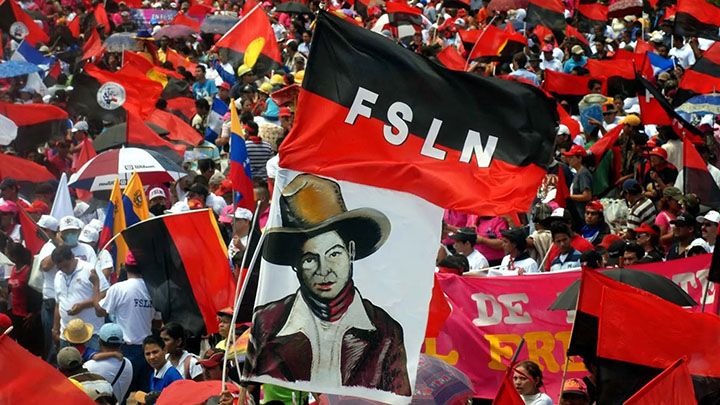
The socialist Sandinista National Liberation Front (FSLN) was inspired by Sandino’s revolutionary war against the US colonial occupation, and fought its own war against a neocolonial US puppet regime.
The Sandinistas toppled Somoza and created a new revolutionary left-wing government on the 19th of July, 1979. Finally, Nicaragua was able to restore its sovereignty.
But the US empire never sleeps. Washington immediately launched another neocolonial war on Nicaragua.
The CIA created far-right death squads, known as the “Contras” (short for “counterrevolutionaries”).
With staunch US government support, the Contra terrorists assassinated Nicaraguan government officials; blew up civilian infrastructure; raped, tortured, and killed civilians; and burned down schools and hospitals.
To help fund their US proxy war on Nicaragua, the Contras also trafficked drugs—and many of those narcotics ended up in US neighborhoods, especially poor, majority Black neighborhoods, which fueled the crack epidemic in the 1980s.
Journalist Gary Webb exposed the CIA’s role in this drug trafficking scheme, in his book Dark Alliance: The CIA, the Contras, and the Crack Cocaine Explosion. The US government punished him by destroying his career. Webb later died in very mysterious circumstances.
In 1984, the government of Nicaragua filed a lawsuit against the United States at the International Court of Justice (ICJ), the top UN legal authority, located at the Hague.
Nicaragua won this case in 1986. The Hague found the US government guilty of carrying out horrific crimes, including bombing civilian infrastructure, putting mines in civilian ports, and overseeing other acts of terror.
The ICJ ordered the US government not only to cease all of these crimes, but also to pay Nicaragua reparations. Washington showed itself to be a complete rogue state; it ignored the Hague’s ruling and continued to wage this criminal terrorist war.
Still to this day, the US government has refused to pay Nicaragua the reparations that it is legally owed according to international law.
A former commander of the CIA-backed Contras published a very revealing article in The New York Times in 1986, titled “Terror Is the Most Effective Weapon of Nicaragua’s ‘Contras’.” This was written by Edgar Chamorro, who was a member of one of the most powerful and wealthiest oligarchic families in Nicaragua.
Chamorro acknowledged that he had previously led the Contras, but he resigned because he said he didn’t want to be a “CIA puppet”. He wrote:
The contras were, and are, a proxy army controlled by the U.S. Government.
If U.S. support were terminated, they would not only be incapable of conducting any military activities against the Sandinistas, but would also immediately begin to disintegrate. I resigned rather than continue as a Central Intelligence Agency puppet.
It is cynical to assert that the contras respect human rights. During my four years as a contra director, it was premeditated policy to terrorize civilian noncombatants to prevent them from cooperating with the Government. Hundreds of civilian murders, mutilations, tortures and rapes were committed in pursuit of this policy, of which the contra leaders and their C.I.A. superiors were well aware.
Chamorro also admitted that the Contras were being led by the former National Guard of the brutal Somoza dictatorship.
Although Chamorro was very anti-Sandinista—again, he had served as a commander of the Contras he reluctantly admitted the truth, writing:
The Sandinistas, for all their faults, have made enormous advances in education, housing and health care, issues of vital importance to Nicaragua’s poor majority. Unfortunately, the ”contras” burn down schools, homes and health centers as fast as the Sandinistas build them.
While Nicaragua’s economy is suffering—partly because of Sandinista mistakes, but more because of the war and the U.S. economic embargo—the Sandinistas must be credited with generating an atmosphere of genuine equality for the first time in Nicaragua’s history. By contrast, the contras who were my colleagues talked mostly of recovering their lost wealth and privileged status.
That article was published in 1986, but everything Chamorro said is still accurate today.
In 2018, the US government sponsored another violent right-wing coup attempt in Nicaragua—once again, involving several family members from the oligarchic Chamorro dynasty.
This coup was led by the same elite, wealthy right-wing forces in Nicaragua, which have been desperate to overthrow the Sandinistas, to reverse the revolution, to privatize the free public health care and education systems, to slash spending on the massive social programs that have helped poor and working-class Nicaraguans, and to obediently subordinate the country to Washington.
China helps Nicaragua develop
Meanwhile, as the United States has invaded, occupied, and terrorized Nicaragua not just for decades, but for centuries, China has been partnering with the country to help it to economically develop.
China is helping Nicaragua to build the massive Punta Huete International Airport … has sent Nicaragua hundreds of new state-of-the-art buses, to strengthen public transportation … has helped Nicaragua to expand its ports, so it can deepen its trade with other countries, and reduce its economic dependence on the United States.
China is helping Nicaragua build large solar plants, so it can have more renewable energy and be less dependent on oil imports and also been helping Nicaragua to build substantial social housing communities. In July 2025, they inaugurated the new neighborhood “Nuevas Victorias”, where 920 houses were built with funding provided by China in solidarity with the people of Nicaragua.
An additional 720 houses will be built in phase two, starting in September.
These are just a few examples of how China is a much better partner for countries in Latin America, as it respects their sovereignty and helps to provide resources to develop according to the economic model they wish to pursue—unlike the US empire, which imposes its own exploitative neoliberal capitalist model on countries and denies them their independence.
The 46th anniversary of the Sandinista Revolution
The Sandinistas have recognized that, in order to defend their country’s sovereignty, they must forge a new path.
Nicaragua has played a key role in pushing for a more multipolar world, in opposition to US imperial hegemony.
The 19th of July, 2025, marked the 46th anniversary of the Sandinista Revolution in Nicaragua. A massive celebration was held in the capital Managua.
The ceremony featured diplomatic representatives from several other countries that have waged revolutionary anti-imperialist struggles of their own, including China, Russia, Palestine, Vietnam, Venezuela, Cuba, Honduras, Burkina Faso, Algeria, the DPRK, and Belarus.
In her speech at the celebration, co-President Rosario Murillo emphasized that “Nicaragua has fought and defeated the imperialists of the planet,” and she stressed the sacred importance of maintaining “peace, which has cost us so much, and for which so many hundreds of thousands of Nicaraguans have given their lives.”
The Sandinistas have waged “frontal combat against poverty in all of its forms”, declared co-President Murillo, while always seeking “dignity, independence, sovereignty, and, of course, well-being.”
In his remarks at the 46th anniversary celebration, co-President Daniel Ortega discussed the role of Nicaragua in the international struggle against imperialism. He honored the brotherly revolutions in other countries that had inspired the Sandinistas.
Co-President Ortega ended his speech warning that, although there is peace in Nicaragua today, “that does not mean that the enemy [the US empire] is resting. The enemy is always conspiring, always trying to provoke bloodshed, always trying to provoke pain in Nicaraguan families, because they believe they can defeat the revolution”.
Ben Norton is an investigative journalist and analyst, and is the founder and editor of Geopolitical Economy Report. He lived in and reported from Latin America for several years, and is now based in Beijing, China.
Source: geopoliticaleconomy.com, July 25, 2025