
By R Allen Wight
In March of this year at UNC Chapel Hill, the winning candidate for president of the Graduate and Professional Student Government (GPSG) was disqualified for a minor infraction against election rules. The circumstances around this scandal don’t just deserve scrutiny; they also offer insight into our political moment and the intersections of progressive organizing in the triangle. Faced with a GPSG election ballot that lacked a progressive candidate, UNC graduate workers looked to run someone who would advocate for them. That role fell to Nyssa Tucker, a fourth-year PhD candidate in Toxicology and Environmental Medicine.
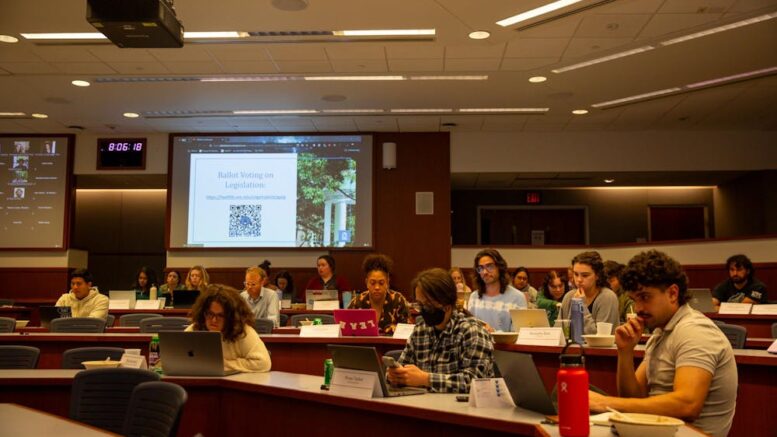
I had the chance to sit down with Tucker (they/them) and discuss the election scandal. They explained why the GPSG Presidential election was so important, “This position has a voice in [the university administration]… and we didn’t think my opponent would serve our interests.” The GPSG president’s access to administration could be used passively as a mouthpiece for the university, or actively to advocate for students. The GPSG and the Undergraduate Student Government (USG) are the two arms of the university’s student government. Both are overseen by a Joint Governance Council that reviews any legislation affecting all students. Although the USG controls a larger budget, the GPSG still has ample resources—and unorganized power.
The Student Supreme Court can arbitrate disputes relating to student government matters. This includes complaints against the Board of Elections (BoE), which administers all student government elections at UNC. The BoE has consistently failed to uphold its own standards, or follow procedures. It is meant to consist of three undergraduate and three graduate students, but too often seats are left vacant, and consequential BoE decisions are made by one or two nonplussed undergraduates.
There have been many scandals; the BoE was sued in the Student Supreme Court once in 2023, three times in 2024, and already four times this year. But more important than the unprofessionalism of 21-year-olds is the question of why college students must advocate for their own basic rights while paying vast sums to get an education. Tucker’s decision to run was made last minute, since the BoE’s abrupt announcement of the election timeline left little room to plan.
The Broader Political Climate
This year, the Trump administration has mobilized secret police to detain and deport international students and professors on college campuses across America. Many more students were suspended or expelled (and evicted from their housing), brutalized and arrested, had visas revoked (including six at UNC), or even had their degrees revoked. Speaking up is dangerous for everyone, but more dangerous for some. “There are many things that put me in a situation of privilege—I present a certain way, and my legal basis for being in the United States is less precarious than others,” Tucker said.
Tucker’s activism and outspoken affiliations with Students for Justice in Palestine (SJP) and UE Local 150 had put them on the administration’s radar prior to the election. They had co-authored a resolution urging UNC to fire an abusive campus cop as well as resolutions of no-confidence in Chancellor Lee Roberts and Provost Chris Clemens. Earlier this year, they were involved in a 2300-signature petition delivery advocating for a living wage at the university. “I interfaced with admin who dared to exit the door and come talk to us… A comment was made to me specifically about being involved with [SJP].”
Tucker campaigned on living wages and public health on campus. “The pay is not good.” They paused. “One could say it’s bad.” They showed me a table from the MIT Living Wage Calculator tool that listed graduate worker annual stipends as percentages of living wage and compared them across multiple schools. UNC’s stipend was the lowest of them all, paying 57 percent of a living wage. And just down the road, Duke’s stipend pays 108 percent.
As a toxicologist, Tucker’s other hot button issue was campus health. “Last year, we found detectable levels of lead in the drinking water at UNC Chapel Hill… likewise, buildings of a certain age on NC State’s campus were above EPA levels of PCBs, which have been linked to cancer clusters and reproductive health issues.” NC State found contaminants in buildings across campus. “Has that [testing] been conducted here at UNC Chapel Hill?” they asked. “No—because once you test, you have to treat.”
The topic feels salient in the wake of NCCU’s brutal police response in April to a protest for decent, healthy housing—for which UNC campus police drove from Chapel Hill to help detain NCCU students. “For me, it’s all about health and well-being—get paid, meet your basic needs, also don’t get cancer.” Tucker makes a compelling pitch. Their campaign was all too compelling, it seems. The BoE, well aware of Tucker’s huge lead in votes, was deliberating behind closed doors about disqualifying them. One former chair of the Joint Governance Council, Matthew Tweden, was involved behind the scenes; though not elected to any office at the time, he knew about Tucker’s enormous lead while the election was ongoing, and he presented the legal precedent in an emergency meeting that the Student Supreme Court then cited to justify Tucker’s disqualification. The influence of someone like Tweden, whose fellowships at the American Enterprise and Ronald Reagan Institutes indicate his rightwing politics, shows the political undertones of something as benign as a student government election.
The Scandal
Tucker ran an issues-focused campaign and won by more than 200 votes. In spite of their landslide victory, the BoE disqualified them, citing a 90-minute late submission of a campaign finance disclosure amounting to zero dollars and zero cents. The board had less severe penalties at their disposal and opted purposely for disqualification. That decision may be legal, but it confounds common sense. Here we see three students, barely quorum, override the decision of more than three hundred voters, or 67 percent of the voting constituency!
Many graduate workers see the GPSG as an opportunity for real advocacy and action. An organization that speaks for the graduate student body should be robust and responsive, but the reality is the opposite. When a student campaign tried to organize the GPSG and empower the student body, establishment players driven by clear political leanings disregarded even GPSG legal statutes to strike the movement down. Clearly, democratic governance at the university is amputated any time students identify their status as workers and may coalition with all workers across campus. Such coalitions must be pursued further.
Different Place, Same Fight
Tucker had more than their own story to tell and went on to offer an analysis. “I’ve been dying to pitch this as a microcosm of our larger political sphere,” they said. These seemingly small developments don’t just have huge consequences for student life—they are tied to broader political currents. The election scandal at UNC happened while NC Republicans were trying to steal a fair victory from Justice Riggs, who’d been endorsed by the Working Families Party and other groups politically left of the DNC. “I’m seeing people say, ‘they’re trying to steal this election from you,’” Tucker noted hearing many “bywords of the last ten years… [like] ‘stop the steal!” They shook their head: “Let’s harness that.”
Boliek’s Ascension
There are a few more interesting characters in this story. Meet Dave Boliek, a former member of the UNC Chapel Hill Board of Trustees, the current North Carolina State Auditor, and namesake of our recent DAVE Act. Last year, Boliek succeeded Democrat Jessica Holmes as State Auditor. As trustee at UNC, Boliek took 2.3 million dollars in funding away from diversity, equity and inclusion initiatives and invested it in “public safety, by which I don’t mean vaccines or making something accessible so you don’t trip,” Tucker continued, “I mean police and surveillance.”
During his campaign, Boliek was endorsed by Trump at a rally in Asheville. Now at the behest of Republican NC Treasurer Brad Briner, the Office of the State Auditor under Boliek’s leadership recently audited the DHHS’ administration of the NC state medicaid program. Tucker continued, “So this same person that we’ve been fighting by proxy through administration and university leadership has now transcended petty internal squabbles [at UNC].” He’s been kicked upstairs and is spearheading DOGE reforms at the state level.
Ubiquitous Predicament
Tucker’s analysis rings true; the influence of trustees and wealthy donors in university politics has been clear as the world reacts to Israel’s ‘final solution’ in Palestine. At Harvard, finance billionaire Bill Ackman invented a narrative of antisemitism on campus and engineered the ousting of former President Claudine Gay. At UPenn, billionaire donor Ronald Lauder and many others threatened to pull funding, and under escalating absurdities former President Liz Magill was eventually forced to step down. The scandal at UNC connects what we normally consider small problems at universities to national, systemic, and geopolitical issues. Because really, it’s the same battles and the same people we’re fighting.
Tucker summed it up, “It seems like a small thing… but the reason I ran is because we wanted a progressive thinker who would be ready to speak up on behalf of student workers.” All manner of institutions across America often rely on right wing forces to disenfranchise pro-labor sentiment; the case was no different here, since worker solidarity in student government could spell problems for UNC’s profit margins.
The Fight Continues
A coalition of graduate workers submitted a petition to recall the new GPSG president on April 10, but the BoE was completely vacant and could not initiate the recall. President Frazier refused to nominate members to the BoE, and on July 10, the Student Supreme Court ordered her to do so by the next GPS Senate meeting on September 9. To stay informed, readers can follow The Workers Union at UNC and the Affirmative Action Coalition at UNC on Instagram.
R Allen Wight is a contributing editor at Triangle Free Press.