
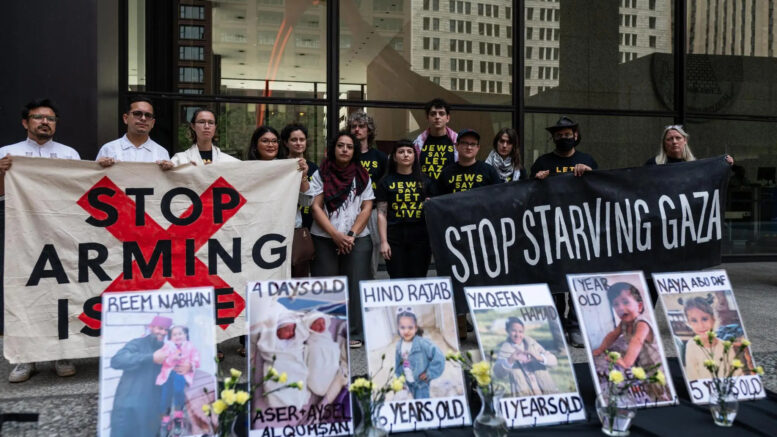
Jewish Voices for Peace lead hunger strike for Gaza
By Joseph Mogul
Ash Bohrer sat in a wheelchair outside of the Chicago Federal Plaza, where they had been arrested for refusing to leave Sen. Tammy Duckworth’s office hours earlier—and where six Jewish Voice for Peace-Chicago organizers had launched a hunger strike for Gaza 18 days prior. Reflecting on the highlights to that point, Bohrer, a JVP-Chicago organizer and Notre Dame peace studies professor, said it wasn’t the teach-ins, solidarity demonstrations or political wins that came to mind first, but a message they received from a mother in Gaza named Alaa.
“When someone in Chicago chooses to face hunger willingly that is not ordinary solidarity,” she wrote. “It is a profound act of pure humanity.”
For Alaa, her three children and 2.1 million Gazans living in constant danger of Israeli bombs, starvation is the other grave threat. On March 2, Israel blocked all aid, including food and baby formula, from entering Gaza. In May, the World Health Organization stated that the entire population of Gaza faces prolonged food shortages and 500,000 people are battling catastrophic hunger.
“Hunger here is not a choice or a political stance,” Alaa’s message read. “Hunger here is a decision made against us.” She wanted the hunger strikers to know, “from the heart of this catastrophe, I say: We see you, we feel you, and your actions reach us even when the borders remain closed.”
After months without any aid entering the besieged Gaza Strip, the U.S.-led Gaza Humanitarian Foundation, or GHF, began distributing small amounts of aid in late May. But to the people of Gaza, GHF is a misnomer.
According to a joint statement published in June by over 240 international human rights organizations, more than 500 Palestinians have been killed and almost 4,000 injured for trying to access aid at GHF sites. Israeli forces and armed groups routinely open fire on starving civilians seeking food. GHF massacres have been documented by firsthand Palestinian accounts and Israeli soldiers who admitted they were ordered to open fire on unarmed Gazans seeking aid. U.S. aid sites have been called “killing fields,” “death traps,” and “the concentration camps of our time.”
Out of these dire conditions, Palestinian organizations in the solidarity movement brought a direct ask to Jewish Voice for Peace: Center the forced starvation of Gaza in their organizing. This message was disseminated at the JVP National Members’ Meeting in May, where local JVP leaders—including those from Chicago—were directed to discuss specifics with their chapters.
“In conversation with the chapter, we decided there is no better way to highlight what starvation is doing to the people of Gaza than to do a solidarity hunger strike,” Bohrer said. They saw the hunger strike as an intuitive way to refuse any pretense that Jewish life is more important than Palestinian life. The message was simple and effective: “While Gazans cannot eat, we will not eat.” This escalation had the dual purpose of centering the forced starvation in Gaza in public discourse and pressuring politicians into action.
Since May, the student movement has adopted hunger strikes as a central tactic. Students at Yale, Stanford, Dartmouth, the University of Oregon, CUNY and dozens more launched concurrent strikes, demanding their universities divest from assets that support the Israeli occupation. They hoped that their hunger strikes would raise awareness of forced starvation in Gaza.
In response to the same crisis, but with a broader scope, JVP-Chicago launched its own indefinite hunger strike on June 16 during a press conference at Federal Plaza, visible from the offices of their elected officials. Over the next 18 days, they co-organized 23 events with 36 movement organizations. Fourteen solidarity strikes were launched across the country, and a network of 60 local volunteers stepped up to support the hunger strikers, while JVP-Chiacgo took the fight to their senator’s doorstep.
The power of solidarity
On day five of the strike, Tzedek Chicago, a local anti-Zionist synagogue led by Rabbi Brant Rosen, hosted a “Shabbat in the streets” at the Federal Plaza. Over 50 community members gathered to sing, pray and call attention to the genocide in Gaza. Tzedek endorsed the strike on day one and encouraged congregants to attend events.
On day 10, JVP highlighted the local lineage of hunger strikes in Chicago, inviting veteran organizers from the Dyett High School, General Iron and Little Village School hunger strikes to lead a teach-in. Lessons were shared from successful parent-led campaigns that pressured the city to reverse decisions to disinvest from schools in Black and low-income communities. This teach-in and much of the programming throughout the 18-day strike emphasized cross-movement connections. Collaborating with 36 organizations from a diversity of political focuses increased engagement and allowed for consistently high turnout at events.
On day 12, 14 JVP chapters around the country organized one-day solidarity fasts to uplift the demands from the Chicago strike. “I fasted to help increase and maintain public attention on the starvation of Palestinians in Gaza and support the social media campaign of the Chicago hunger strike,” said Ray Himmelman, organizer with Twin Cities JVP.
The Chicago strikers also received an outpouring of international support and messages of solidarity from France, Ireland, Egypt and Palestine. They were even visited by Motaz Azaiza, a Palestinian journalist from Gaza who was on a speaking tour in Chicago.
Mounting political victories
As the widespread support generated by the strike mounted pressure on politicians, JVP-Chicago achieved some tangible political victories. They secured meetings with federal legislators, including Reps. Mike Quigly, Robin Kelly and Bill Foster, to discuss the Block the Bombs Act—a bill currently in the House that, if passed, would prevent the Trump administration from delivering major U.S. weapons to Israel. Rep. Danny Davis agreed to co-sponsor the bill after meeting with hunger strikers, likely a result of the political pressure by JVP. Several elected officials also attended their events, including Rep. Delia Ramirez, State Sen. Gabriela Guzman and multiple city alders.
In addition to these legislative wins, 25 stories in local and national publications covered the hunger strike, and they raised nearly $15,000 for Middle East Children’s Alliance.
As the wins piled up, JVP attempted to leverage its momentum to secure a meeting with Sen. Tammy Duckworth, who sits on the Foreign Relations Committee and who Rips describes as having “supported Israel with a blank check.” (Sen. Duckworth has received over $780,000 from Pro-Israel PACs). For years, Duckworth refused to meet with Palestinians and their supporters, despite Chicago having the largest Palestinian population of any U.S. city.
During the first week of the strike, JVP managed to meet with a staffer, who promised to let them know whether Duckworth herself would meet with them by July 1 (day 16 of the hunger strike).
A final escalation
As the deadline for a response from Sen. Duckworth’s office came and went, the strikers’ vitals were trending down and the community care team was running low on capacity.
On July 3, day 18, it was time for one final escalation.
Members from JVP-Chicago, including two hunger strikers in wheelchairs, approached Sen. Duckworth’s office to ask for a meeting in person. They attempted to enter but found the doors locked. According to Bohrer and Rips, the staff pretended that nobody was in the office (a claim since repeated), despite answering the intercom. After confirming with Duckworth’s other offices that the Chicago office was indeed open that day, they flooded the Chicago staff with calls saying they weren’t leaving without a meeting.
“In response to that, they called the Federal Protective Service,” Bohrer said. “They handcuffed everybody who was at the office, including myself and one other hunger striker.” Eight members of JVP-Chicago were charged with failure to comply and disorderly conduct.
Hours after they were arrested and released, Bohrer said, “It’s very energy intensive to be arrested. What happens from here remains to be seen. We are feeling extra exhaustion and tiredness and pain in our bodies.”
The hunger strikers hope their action can inspire future strikes, and they carry many lessons forward. One of the biggest takeaways is the importance of community support.
“A hunger strike takes a village,” Bohrer said. “We think about the individual people who are forgoing food, but it takes a team.” Another lesson is that to be effective, you can’t just starve at home—you have to bring your bodies and message to elected officials’ offices every single day and pressure them to act.
“We put this issue in front of millions of eyes, so even if this is a drop in the bucket, it’s a bucket we are trying to collectively fill with justice,” Rips said. “And I’m honored to put a drop in it.”
If the JVP Chicago hunger strike is indeed just a drop in the bucket, it’s a drop that will have ripple effects for courageous acts to come.
Joseph Mogul is an anti-Zionist Jewish writer, organizer, and independent journalist currently based in Brooklyn, New York.
Source: wagingnonviolence.org, July 11, 2025